
Physician credentialing is a critical process that determines your ability to see patients and receive reimbursement from insurance payers. With new NCQA standards taking effect in 2025 and increasing automation in healthcare administration, understanding how to expedite your credentialing process has never been more important. This comprehensive guide provides actionable strategies to minimize delays and ensure successful physician credentialing outcomes.
Understanding the Current Physician Credentialing Landscape in 2025

The physician credentialing environment has undergone significant changes. In 2025, the National Committee for Quality Assurance (NCQA) shortened verification timelines: NCQA-accredited organizations must complete credentialing in 120 days (down from 180), and NCQA-certified organizations have just 90 days (down from 120).
Credentialing bottlenecks persist due to higher volumes, staffing shortages, and evolving post-pandemic regulations. Some payers report processing times of 60–120 days or more, straining practice revenue cycles and delaying provider onboarding.
Why Physician Credentialing Delays Occur
Credentialing delays arise from multiple interconnected factors that can significantly slow provider onboarding and reimbursement eligibility:
-
Incomplete or Missing Documentation: Studies show up to 30% of credentialing packets are held for additional information—missing items such as expired licenses, unsigned attestation forms, or absent training certificates. Tailoring checklists to each payer and conducting pre-submission audits can cut this hold rate in half.
-
Human Error and Administrative Oversights: Manual entry mistakes—transposed NPIs, incorrect license numbers, or typos in specialty codes—often add 10–15 business days per error cycle. Implementing dual-entry verification or simple spot checks reduces these delays.
-
Variability in Payer-Specific Requirements: With over 1,000 commercial and government payers, each with proprietary credentialing portals and documentation protocols, lack of familiarity leads to multiple rounds of clarification.
-
Poor Application Tracking and Follow-Up: Without automated status tracking and scheduled outreach, applications can stall indefinitely. Organizations that centralize credentialing ownership and use real-time dashboards reduce follow-up loops by 40%.
-
Seasonal Volume Surges and Staffing Constraints: Payer backlogs during Open Enrollment or renewals can extend processing times to 90–120 days. Concurrent staffing shortages amplify these delays, making proactive scheduling crucial.
-
Enhanced Regulatory Scrutiny and NCQA Mandates: The 2025 NCQA standards require faster verification (90–120 days) and monthly monitoring. Any deviation from these tighter deadlines results in escalations and rework.
By leveraging a hybrid model that combines dedicated credentialing coordinators, automated reminders, and regular status reviews, organizations can mitigate these risks and accelerate approvals.
The Essential Document Checklist for Physician Credentialing
Credentialing success begins with documentation. Missing or outdated files are the leading cause of delays and denials. The table below breaks down each required document and what it must include to pass verification standards in 2025:
Most Overlooked Credentialing Requirements
Even experienced providers can overlook some credentialing essentials, especially when juggling multiple payer applications. These often-missed items can delay credentialing or lead to rejections, especially under the tighter NCQA standards introduced in 2025. Below is a table summarizing these critical yet frequently neglected requirements:
Strategic Application Tracking and Management
Credentialing timelines are often derailed by poor follow-up and disorganized application tracking. In today’s high-volume environment—where providers may be juggling 10+ payer applications simultaneously—manual tracking is no longer viable. To reduce the risk of credentialing delays and ensure real-time visibility, organizations should adopt structured tools and processes.
The following tools and best practices are essential:
A best-in-class credentialing workflow doesn’t rely on memory or sticky notes—it integrates reminders, secure storage, and smart dashboards to reduce lags and missed deadlines. Organizations that implement these strategies reduce rework by up to 40% and accelerate provider onboarding timelines by 2–4 weeks on average.
Best Practices for Expedited Credentialing
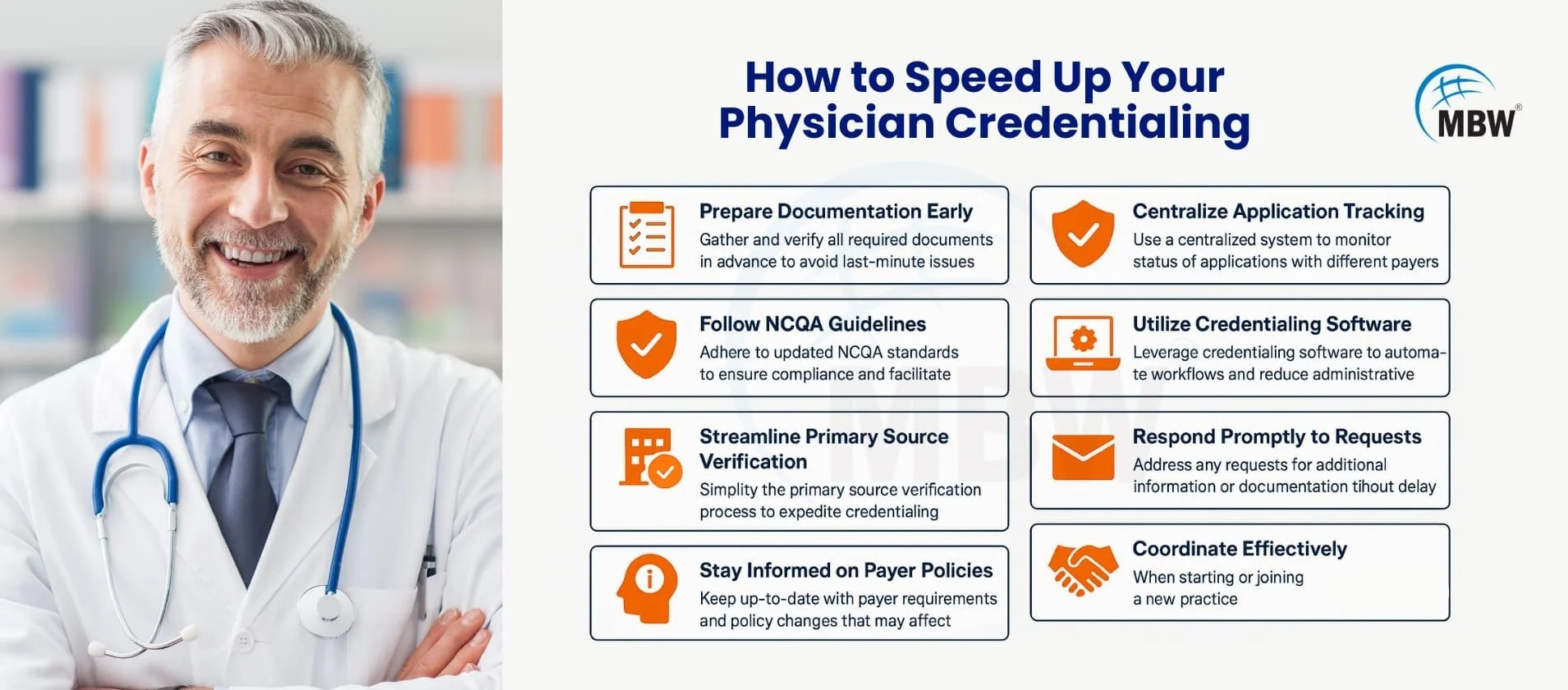
Credentialing is often viewed as a back-office function, but it directly impacts provider start dates, cash flow, and patient access. With insurers tightening their enrollment timelines and compliance oversight increasing in 2025, adopting best practices is no longer optional—it’s essential.
Below are practical strategies organizations can adopt to streamline credentialing:
-
Start Early – Begin the credentialing process as soon as a job offer is extended or contract negotiations begin. Some systems initiate credentialing 120–180 days in advance to mitigate payer lag.
-
Submit Complete Packages – Incomplete submissions are the #1 reason for processing delays. Bundling all documentation into a single, organized packet reduces rework and ensures the application can be processed immediately.
-
Use Electronic Tools – Most major payers now accept digital applications. Using electronic platforms (like PECOS for Medicare or CAQH for commercial payers) allows for faster uploads, e-signatures, and real-time validation.
-
Maintain CAQH ProView – Keep CAQH profiles up to date every 120 days. This is a required source for most insurers, and an inactive profile can cause credentialing stalls across multiple plans.
-
Build Payer Relationships – Having a dedicated contact at each payer organization can help expedite reviews, troubleshoot missing data, and advocate for application prioritization. Relationship-based outreach consistently yields faster responses during high-volume periods.
By applying these best practices, healthcare organizations can reduce credentialing turnaround times by 30–50%, shorten revenue cycles, and avoid unnecessary delays in patient care delivery.
Leveraging Technology and Automation
Technology alone won’t solve every credentialing delay—but when combined with expert human oversight, it can dramatically accelerate timelines and reduce costly errors. In 2025, top-performing organizations blend smart tools with experienced credentialing professionals to ensure applications are both complete and accurate.
Here are key areas where expert-enabled technology makes a difference:
-
Expert-Verified License & Education Checks – Instead of relying solely on automated credentialing bots, best-in-class systems integrate credentialing professionals who conduct final reviews, verify hard-to-source data, and manage exceptions flagged by systems.
-
Real-Time Alerts – Credentialing platforms like Modio, Silversheet, and IntelliCred now send real-time reminders for expiring licenses, board certifications, and CAQH profile status. These alerts help teams stay ahead of credentialing gaps.
-
Cloud-Based Workflows – Digital platforms centralize credentialing documents, allow remote access, and track every stage of the application process. Shared dashboards increase visibility across teams and improve turnaround by up to 30%.
-
Sanction & Exclusion Monitoring – Monthly automated checks of the OIG List of Excluded Individuals/Entities (LEIE), SAM.gov, and state databases are now the norm. They’re often supported by compliance officers who escalate issues quickly.
While automation adds speed and consistency, human verification ensures accuracy, interpretation of gray areas, and relationship-based follow-ups with payers. In credentialing, speed without precision is a liability—hybrid models strike the right balance.
Understanding the 2025 NCQA Standards Impact
The National Committee for Quality Assurance (NCQA) has implemented pivotal updates to its credentialing standards in 2025 that will significantly affect how healthcare organizations manage enrollment and compliance.
These changes are designed to enhance transparency, accountability, and efficiency in the credentialing process. However, they also place added pressure on healthcare administrators and RCM leaders to adapt workflows quickly and adopt modern tools and practices.
Here’s what’s changed and why it matters:
These standards reflect the industry’s broader push toward value-based care and operational accountability. Practices that fail to meet the updated requirements risk accreditation jeopardy, enrollment delays, and payer relationship strain.
The takeaway: compliance is no longer just about checking boxes—it’s about proving your systems can keep up with today’s pace of change. Credentialing teams must stay nimble, tech-enabled, and compliance-forward to thrive in this environment.
Special Considerations by Provider Type
Credentialing needs vary significantly based on a provider’s practice model, service location, and clinical specialty. Understanding these distinctions ensures timely and compliant onboarding—especially as payer scrutiny and digital tracking increase. Here’s how credentialing differs by provider type:
Tailoring your credentialing process to the nuances of each provider’s role helps eliminate bottlenecks and ensures faster onboarding while reducing audit risks.
Revenue Impact and Financial Considerations
Delays in physician credentialing have a direct and often underestimated impact on healthcare revenue cycles. Every day a provider remains uncredentialed translates to lost billing opportunities and mounting financial strain.
Here’s how these delays translate into financial terms:
To minimize these financial risks, organizations must tightly monitor credentialing metrics and integrate them into broader RCM dashboards. Leading practices also conduct monthly audits of uncredentialed providers and pending payer approvals to proactively address bottlenecks.
Credentialing isn’t just a compliance requirement—it’s a revenue lever. Understanding and managing its financial impact can drive faster onboarding, healthier cash flow, and more predictable revenue cycles.
Quality Assurance and Compliance
Credentialing success hinges on more than just submission speed—maintaining quality assurance and compliance is crucial for protecting both revenue and licensure status. As credentialing standards tighten and audits become more frequent, organizations must shift from reactive fixes to proactive governance.
Organizations that build compliance into their credentialing workflows—from initial application through recredentialing—avoid costly errors, failed audits, and reputational harm. Quality is no longer optional—it’s the foundation of sustainable, scalable physician onboarding.
Conclusion: Credentialing Success in 2025
Credentialing isn’t just paperwork—it’s the gatekeeper of your practice’s cash flow. Success in 2025 requires digital tools, organized processes, and relentless follow-through. When done right, credentialing is no longer a barrier—it becomes a competitive advantage.
Need help navigating credentialing in 2025? MBW RCM provides end-to-end support for credentialing and payer enrollment. Let’s ensure your providers are ready to bill—and get paid—faster.