
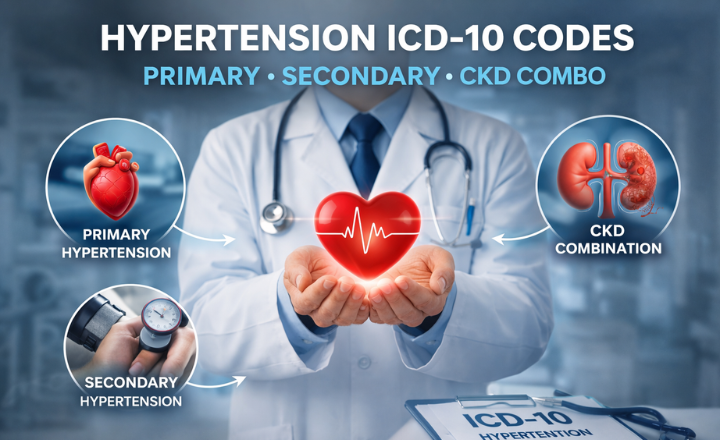
Hypertension ICD-10 codes — primary, secondary, CKD combo refer to the diagnosis codes used in the ICD-10-CM system to classify different types of high blood pressure conditions, including essential hypertension, secondary hypertension, and cases linked with chronic kidney disease or heart disease.
These conditions fall within the I10–I16 code range, which organizes hypertension based on its cause and related complications. This guide explains the key hypertension codes, how they are categorized in ICD-10, and how they are applied in medical documentation and coding.
How the ICD-10 System Categorizes Hypertension Conditions
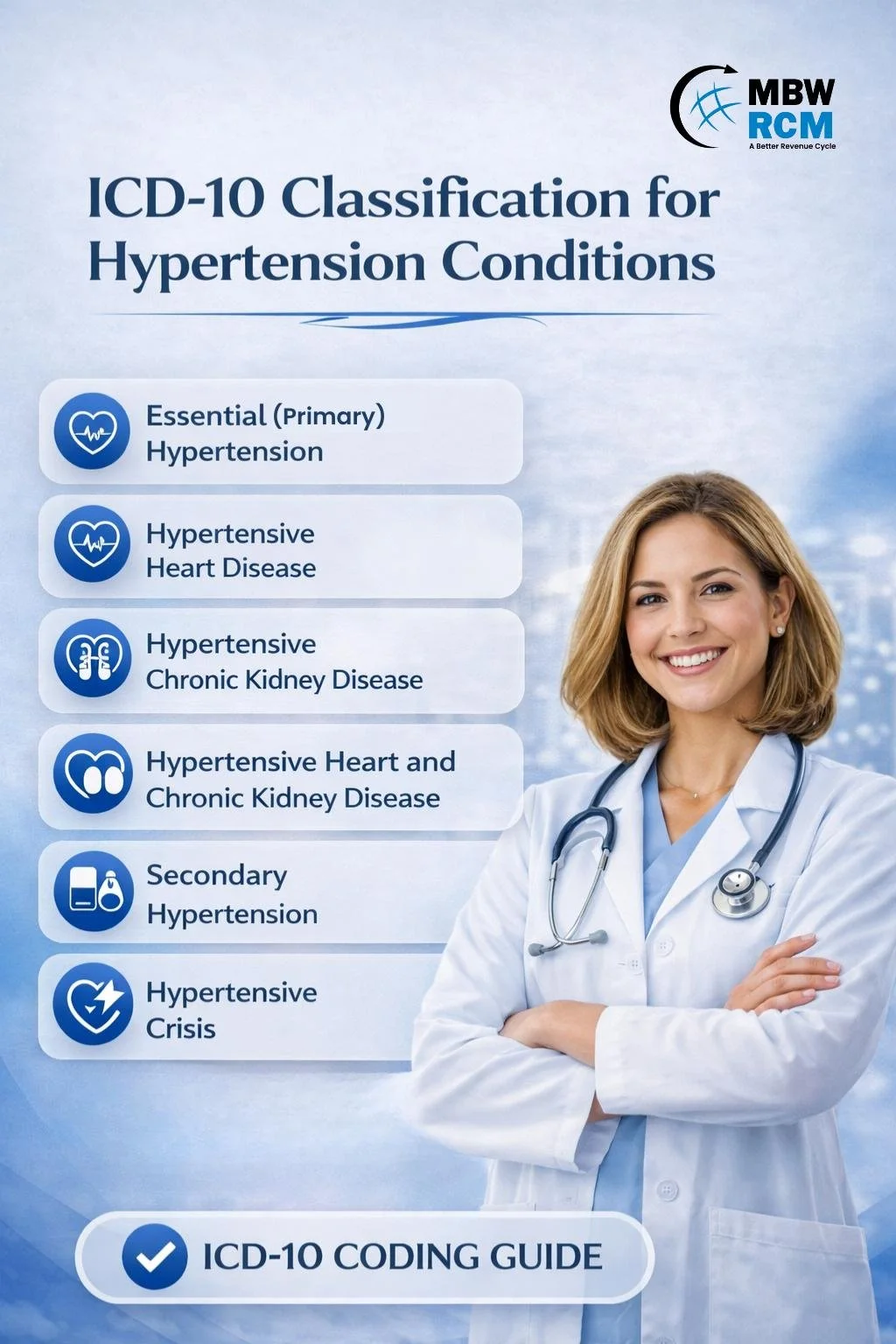
The ICD-10-CM coding system classifies hypertension based on its cause, organ involvement, and severity. These conditions are grouped within the I10–I16 code range under circulatory system diseases.
Hypertension in ICD-10 is categorized as:
-
I10 – Essential (Primary) Hypertension
-
I11 – Hypertensive Heart Disease
-
I12 – Hypertensive Chronic Kidney Disease
-
I13 – Hypertensive Heart and Chronic Kidney Disease
-
I15 – Secondary Hypertension
-
I16 – Hypertensive Crisis
Because hypertension can affect multiple organs, ICD-10 includes combination codes that capture both the condition and related complications. This supports accurate documentation, billing, and tracking of long-term cardiovascular risks.
ICD-10 Code for Primary (Essential) Hypertension
Primary hypertension, also known as essential hypertension, accounts for 90–95% of all hypertension cases. It develops gradually without a clearly identifiable underlying cause.
The ICD-10-CM diagnosis code for primary hypertension is:
I10 – Essential (Primary) Hypertension
This code is used when a patient has consistently elevated blood pressure (≥130/80 mmHg) without evidence of secondary causes such as kidney disease or endocrine disorders.
Essential hypertension is typically diagnosed during routine visits when high blood pressure readings persist across two or more visits over several days or weeks. The I10 code is assigned when documentation confirms primary hypertension without related organ damage.
ICD-10 Codes Used for Secondary Hypertension
Secondary hypertension occurs when an identifiable condition causes elevated blood pressure. It is less common than primary hypertension but often develops suddenly and may affect younger patients.
ICD-10-CM classifies secondary hypertension under the I15 category, including:
-
I15.0 – Renovascular hypertension
-
I15.1 – Hypertension secondary to renal disorders
-
I15.2 – Hypertension secondary to endocrine disorders
-
I15.8 – Other secondary hypertension
-
I15.9 – Secondary hypertension, unspecified
Several conditions can lead to secondary hypertension. Examples include chronic kidney disease, adrenal gland disorders, thyroid dysfunction, and renal artery stenosis. In many cases, treating the underlying condition may reduce or control blood pressure levels.
Proper documentation is important when assigning Hypertension ICD-10 codes, as the underlying cause must be clearly identified.
Hypertension ICD-10 Codes with Chronic Kidney Disease (CKD)
Hypertension and chronic kidney disease (CKD) often occur together. Long-term high blood pressure can damage kidney blood vessels, while kidney dysfunction can contribute to persistent hypertension. Because of this relationship, ICD-10 provides combination codes for hypertensive chronic kidney disease.
These conditions fall under the I12 category:
-
I12.0 – Hypertensive chronic kidney disease with stage 5 CKD or end-stage renal disease
-
I12.9 – Hypertensive chronic kidney disease with stage 1–4 CKD
ICD-10 guidelines also require an additional code (N18.1–N18.6) to specify the CKD stage. For example, a patient with hypertension and stage 3 CKD would be coded I12.9 with N18.3.
ICD-10 Codes for Hypertension with Heart Disease
Long-standing hypertension can lead to heart-related conditions such as left ventricular hypertrophy, coronary artery disease, or heart failure. In ICD-10-CM, these are classified as hypertensive heart disease.
Relevant codes fall under the I11 category:
-
I11.0 – Hypertensive heart disease with heart failure
-
I11.9 – Hypertensive heart disease without heart failure
When heart failure is present, ICD-10 guidelines require assigning an additional code from the I50 series to specify the type of heart failure.
Using the correct combination of codes helps ensure accurate billing and proper classification of hypertensive heart disease.
ICD-10 Codes for Hypertensive Crisis (Urgency and Emergency)
A hypertensive crisis refers to a sudden and severe rise in blood pressure, typically above 180/120 mmHg, which may require urgent medical evaluation.
In ICD-10-CM coding, hypertensive crisis is classified under the I16 category:
-
I16.0 – Hypertensive urgency
-
I16.1 – Hypertensive emergency
-
I16.9 – Hypertensive crisis, unspecified
In hypertensive urgency, blood pressure is elevated without immediate organ damage, while hypertensive emergency involves complications affecting organs such as the brain, heart, or kidneys. If you are interested to read more about hypertension ICD-10 codes, please have a look at this blog on ‘‘How Hypertensive Diseases Are Documented & Coded in ICD-10’’.
Complete List of Common ICD-10 Codes for Hypertension
Medical coders frequently encounter hypertension-related diagnosis codes in clinical records and billing. The common ICD-10 codes for hypertension cover conditions such as essential hypertension, hypertensive heart disease, CKD-related hypertension, secondary hypertension, and hypertensive crisis.
Quick Lookup Table for Hypertension Diagnosis Codes
⭐ Most common code: I10 – Essential hypertension
Coding Tip
When hypertension is associated with heart failure or chronic kidney disease, ICD-10 guidelines may require additional codes (such as I50 or N18 series) to fully describe the condition for accurate billing. For a quick reference on commonly used cardiology billing codes and guidelines, use this cardiology billing cheat sheet to simplify coding and billing processes.
Best Practices for Coding Hypertension Combinations
Coding hypertension requires reviewing physician documentation to determine whether other conditions are linked to elevated blood pressure. Combination coding is common when hypertension occurs with heart disease, kidney disease, or endocrine disorders.
Key practices include:
-
Review clinical notes to identify the underlying cause.
-
Confirm documented complications or organ involvement.
-
Apply combination codes when ICD-10 guidelines indicate a relationship.
-
Assign additional codes for conditions such as CKD stages or heart failure types.
These steps help ensure accurate use of hypertension ICD-10 codes in medical documentation and billing. Need more guidance on accurate coding practices? Check out our detailed guide on cardiology coding guidelines & best practices to learn how proper documentation and coding workflows can support consistent medical billing.
Common Coding Errors When Reporting Hypertension Diagnoses
Proper coding of hypertension requires correct classification of related conditions and adherence to ICD-10 guidelines. Errors often occur when combination rules or additional coding requirements are overlooked.
-
Incorrect Use of I10 Instead of Combination Codes
A common error is assigning I10 (essential hypertension) when documentation indicates conditions like hypertensive heart disease or CKD. In such cases, codes from I11, I12, or I13 should be used.
-
Missing Additional Codes for CKD or Heart Failure
ICD-10 requires additional codes such as N18 (CKD stages) or I50 (heart failure types). Missing these can result in incomplete coding.
-
Failure to Link Hypertension with Related Conditions
Hypertension may be coded separately even when it is related to heart or kidney disease. ICD-10 guidelines often require combination coding in these cases.
Conclusion:
Correctly identifying hypertension codes helps simplify diagnosis reporting and improve medical documentation. Using the appropriate ICD-10 codes supports clearer patient records and consistent clinical reporting.
For practices handling cardiovascular cases, reliable cardiology billing services can support accurate coding, smoother claims processing, and better documentation management. For more details or assistance, contact our team.
Applying This Cardiology Coding Cheat Sheet in Practice
This cardiology coding cheat sheet helps identify the correct CPT codes for EKG, stress tests, and cath lab procedures. Clear documentation of the procedure and physician interpretation is important when selecting the appropriate code.
Understanding whether a service is billed as a global, technical, or professional component helps improve billing accuracy and reduce claim denials.