
Left knee pain is among the most frequent issues patients bring to healthcare providers. It’s seen in primary care, orthopedics, urgent care, and physical therapy. For clinicians, the focus is on diagnosing and managing the condition. For coders and billers, the challenge is ensuring that the diagnosis is captured correctly in ICD-10. Even a minor error—such as coding the wrong side or relying on an unspecified option—can result in claim denials, reimbursement delays, and compliance headaches.
This quick-reference guide gives you everything you need about ICD-10 code M25.562 (Pain in left knee), including:
-
What the code means and when to use it
-
Related knee pain ICD-10 codes
-
Key documentation requirements
-
Billing guidelines and payer considerations
-
Frequent coding mistakes to avoid
-
Why accuracy is critical for your practice
ICD-10 Code M25.562: Pain in Left Knee
The ICD-10-CM designation for pain in the left knee is:
-
M25.562 – Pain in left knee
What does M25.562 indicate?
This is a specific and billable ICD-10 code used when pain is localized to the left knee joint. Unlike ICD-9, ICD-10 requires laterality, meaning coders must specify whether the problem is in the left, right, or unspecified knee.
👉 You can look up this code in the official CDC ICD-10-CM Browser Tool.
When should you assign this code?
Use M25.562 if:
-
The chart notes pain specifically in the left knee.
-
The underlying cause has not been identified or documented.
-
A billable diagnosis is needed to justify the encounter or service.
📌 Tip: If the provider documents a clear diagnosis such as osteoarthritis, bursitis, or tendinitis, it’s better to report that specific condition rather than (or in addition to) pain.
Other ICD-10 Codes for Knee Pain
While M25.562 is the go-to code for left knee pain, other options may apply depending on the case.
Right knee pain (M25.561)
-
M25.561 – Pain in right knee
For pain clearly noted in the right knee.
Unspecified knee pain (M25.569)
-
M25.569 – Pain in unspecified knee
Use this only when documentation does not state laterality. Since many payers reject unspecified codes, avoid it when possible.
Codes for specific causes
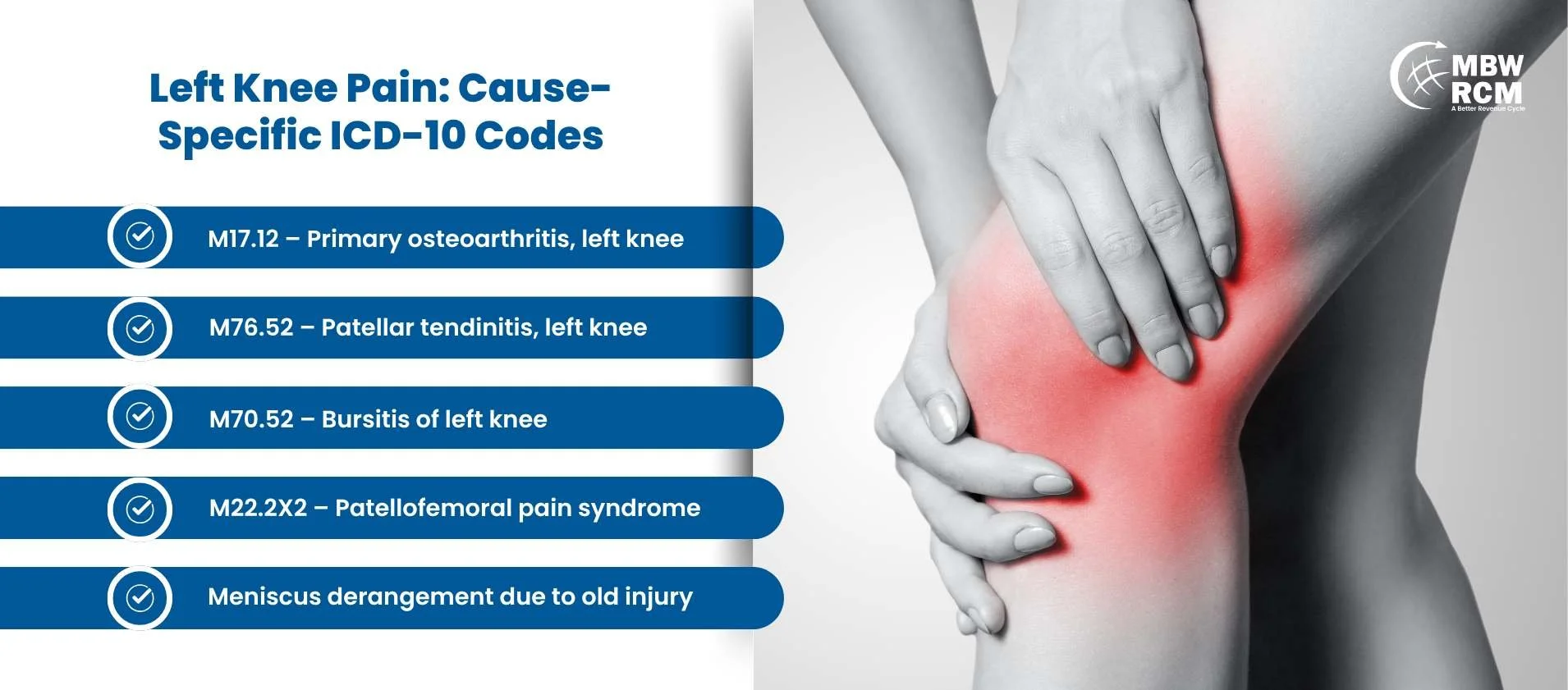
When the cause of knee pain is documented, more precise coding should be used:
-
M17.12 – Primary osteoarthritis, left knee
-
M76.52 – Patellar tendinitis, left knee
-
M70.52 – Bursitis of left knee
-
M22.2X2 – Patellofemoral pain syndrome, left knee
-
M23.202 – Meniscus derangement due to old injury, left knee
📌 Example: If imaging shows osteoarthritis in the left knee, use M17.12 rather than just M25.562.
If you are interested to read more about Orthopedic Billing, please have a look at this blog on Orthopedic Surgery Coding Guide: optimize Your Daily Workflow
Documentation Guidelines for Coding Left Knee Pain
Accurate coding depends on accurate documentation. Providers should include:
-
Laterality: Always indicate left, right, or both.
-
Chronicity: Document whether pain is acute, chronic, or recurrent.
-
Cause: Identify traumatic vs. degenerative origin.
-
Encounter type: Use the correct 7th character for injuries:
-
A – Initial encounter
-
D – Subsequent encounter
-
S – Sequela
-
📌 Example: A patient presents with acute pain after twisting the left knee during sports. Document: “Left knee sprain, initial visit.” Code: S83.91XA.
Billing with ICD-10 Code M25.562
Assigning the right ICD-10 code is only part of the process. Billing requires matching diagnosis codes with CPT and payer guidelines.
-
Link to CPT codes: Example: CPT 73560 (X-ray, knee, two views) may pair with M25.562 when ordered for left knee pain.
-
Use secondary codes: If pain is linked to another diagnosis (like arthritis or injury), code both the condition and M25.562.
-
Check payer rules: Medicare and commercial payers often have specific medical necessity requirements. Review CMS ICD-10 resources before submitting claims.
Frequent ICD-10 Coding Errors to Avoid
-
Unspecified codes: Don’t use M25.569 if documentation specifies “left knee.”
-
Wrong laterality: Left vs. right mix-ups are a common denial reason.
-
Incorrect 7th character: For injuries, ensure encounter type matches the visit.
-
Missing condition codes: If arthritis, bursitis, or tendinitis is documented, don’t just code pain.
Why Accurate Coding of M25.562 Matters
Proper ICD-10 coding is not just about compliance—it directly impacts your practice’s financial health.
-
Fewer denials: Specific codes like M25.562 result in faster reimbursements.
-
Compliance: Documentation that supports the diagnosis ensures audit readiness.
-
Revenue cycle efficiency: Partnering with expert medical coding and audit services can help reduce errors and protect your bottom line.
Final Thoughts
Think of M25.562 as your standard code for left knee pain, but don’t stop there:
-
Always document laterality.
-
Use specific diagnosis codes when available.
-
Pair ICD-10 with the right CPT codes.
-
Avoid unspecified or vague coding.
By following these practices, you’ll reduce denials, improve revenue flow, and keep your practice audit-ready.
Looking for the Best Medical Coding Services in US?
Are you considering outsourcing your medical coding but not sure where to start? The right partner can make all the difference in streamlining your revenue cycle management. Fill the form below and talk with experts.