

Medical billing for anesthesia practices is unlike billing for any other specialty. With time-based units, concurrent procedures, and complex modifiers, the process often leads to claim errors and delays.
This guide answers your biggest questions on medical billing for anesthesia, from modifiers to billing software—and helps you fix the bottlenecks in your revenue cycle.
1. What Makes Anesthesia Medical Billing So Different From Other Specialties?
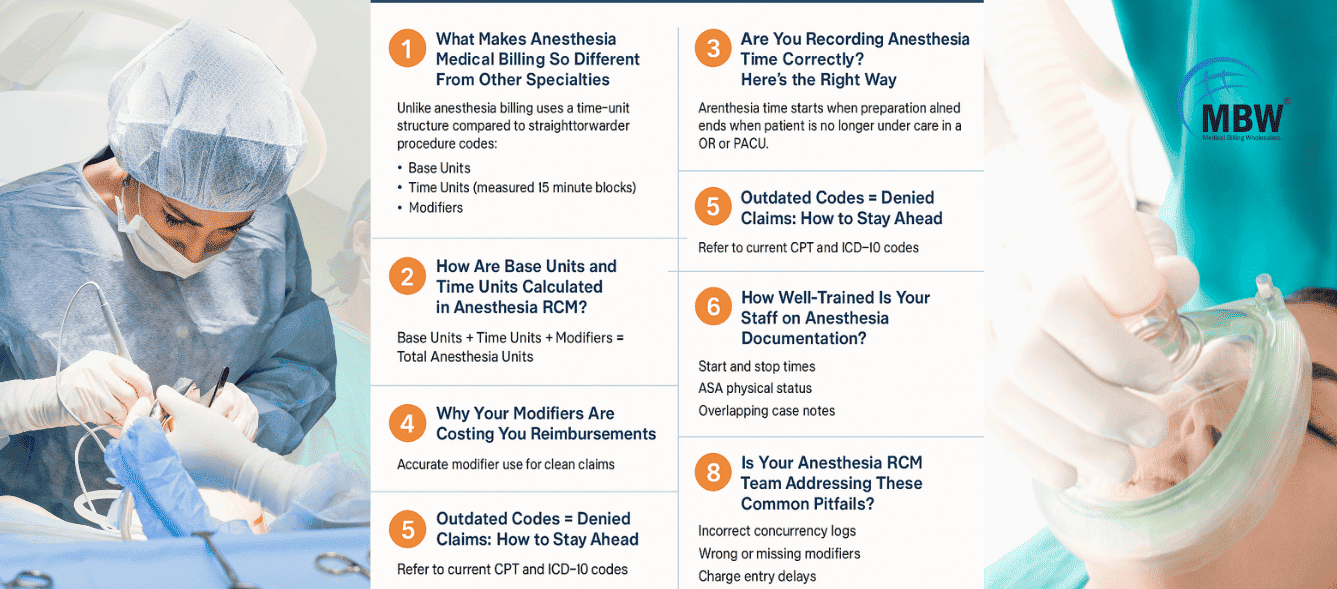
Unlike E/M coding, medical billing for anesthesia relies on a time-unit structure rather than straightforward procedure codes. Anesthesia procedures include:
-
Base Units – Assigned based on the type of procedure
-
Time Units – Measured in 15-minute blocks
-
Modifiers – Indicate who performed what
This model increases the risk of billing errors, especially without the right anesthesia billing software or support from a skilled anesthesia billing company.
2. How Are Base Units and Time Units Calculated in Anesthesia RCM?
Anesthesia RCM uses this formula:
Base Units + Time Units + Modifiers = Total Anesthesia Units
Here’s how time converts into billing units:
Getting time documentation right is foundational to medical billing for anesthesia success.
“If you’re off by even one unit, you might as well be billing Monopoly money.”
3. Are You Recording Anesthesia Time Correctly? Here’s the Right Way
Anesthesia time starts when the anesthesiologist begins preparing the patient and ends when the patient is no longer under their care in the OR or PACU.
Start time ≠ Incision time.
Using accurate, minute-by-minute time tracking improves billing transparency and avoids denials in medical billing for anesthesia scenarios.
4. Why Your Modifiers Are Costing You Reimbursements
Incorrect use of Anesthesia billing modifiers is one of the most common causes of underpayment in anesthesiologist billing services.
Accurate modifier use is essential for clean claims in medical billing for anesthesia.
5. Outdated Codes = Denied Claims: How to Stay Ahead
With frequent CPT and ICD-10 updates, outdated codes can sink your reimbursements. Every anesthesia billing company should:
-
Subscribe to payer newsletters
-
Attend coding workshops
-
Use current-year coding books
-
Automate compliance checks via software
According to MGMA, nearly 12% of anesthesia claims are denied due to outdated or incorrect codes.
For reliable coding guidance, providers can refer to the American Society of Anesthesiologists (ASA) — a nonprofit leader in medical billing for anesthesia education.
Still Using Generic Billing Tools? Here’s Why That’s Hurting You
Most generic medical billing services can’t handle the complexity of medical billing for anesthesia. Instead, you need:
-
Real-time time tracking
-
Modifier logic automation
-
Concurrent case tracking
-
Integration with your EHR
Check out our anesthesia billing and coding services to see how we support solo providers and large groups with complete billing support.
6. How Well-Trained Is Your Staff on Anesthesia Documentation?
Even the best billing tech can’t correct poor documentation. To reduce denials, staff must log:
-
Start and stop times
-
ASA physical status
-
Procedure type
-
Overlapping case notes
This level of accuracy makes all the difference in medical billing for anesthesia.
7. Payer Rules Are Not One-Size-Fits-All and That’s the Problem
Each payer has unique rules for medical billing for anesthesia. For example:
-
Some cap time units at 4
-
Others require Q-modifiers
-
Medicare has concurrency limits
That’s why outsourcing to an anesthesia billing company can help you avoid costly policy missteps and missed payments.
Learn more about how we support practices through our Revenue Cycle Services.
8. Is Your Anesthesia RCM Team Addressing These Common Pitfalls?
Top RCM mistakes in medical billing for anesthesia include:
-
Incorrect concurrency logs
-
Wrong or missing modifiers
-
Charge entry delays
-
Manual billing input errors
Address these issues by improving your revenue cycle management structure. Tools like concurrent scheduling dashboards and automatic alerts in anesthesia billing solutions help mitigate these risks. If you’re considering outside help, here’s a helpful resource on how to choose the right anesthesia billing company to support your practice.
9. Data Doesn’t Lie: How Analytics Can Transform Anesthesia Billing
By using data analytics, providers improve:
-
Denial pattern recognition
-
Payer response time tracking
-
Claim resubmission accuracy
-
RCM efficiency
Modern anesthesia billing solutions integrate these insights for better billing decisions in real time.
“Your job is to put patients to sleep. Ours is to keep your revenue wide awake.”
Get Expert Help with Medical Billing for Anesthesia Practices
Selecting the right support for medical billing for anesthesia can save your practice time and money. Whether you’re independent or managing multiple locations, the right team helps improve accuracy and speed.
Partnering with a specialized anesthesia billing company ensures:
-
Custom RCM workflows
-
Fewer denials and write-offs
-
Timely payer communications
-
Full billing transparency
Ready to improve your collections? Get a quote or contact our team today.