

Denial Management Solutions help healthcare organizations track monthly denial reasons effectively by offering structured methods to log, categorize, and analyze claim rejections. With monthly tracking, providers can quickly detect trends, correct errors, and prevent revenue loss. This blog highlights actionable strategies for consistent, data-driven denial management.
Understanding the Importance of Monthly Denial Tracking
Monthly denial tracking reveals real-time issues that impact claim success, revenue flow, and process efficiency. It allows providers to detect recurring trends early, make timely corrections, and avoid preventable losses. Compared to quarterly reviews, this approach enables faster response, better training alignment, and improved payer compliance. Denial Management Solutions are most effective when used to guide these monthly evaluations.
Here Are the Top Denial Management Solutions to Track Monthly Denial Reasons Effectively
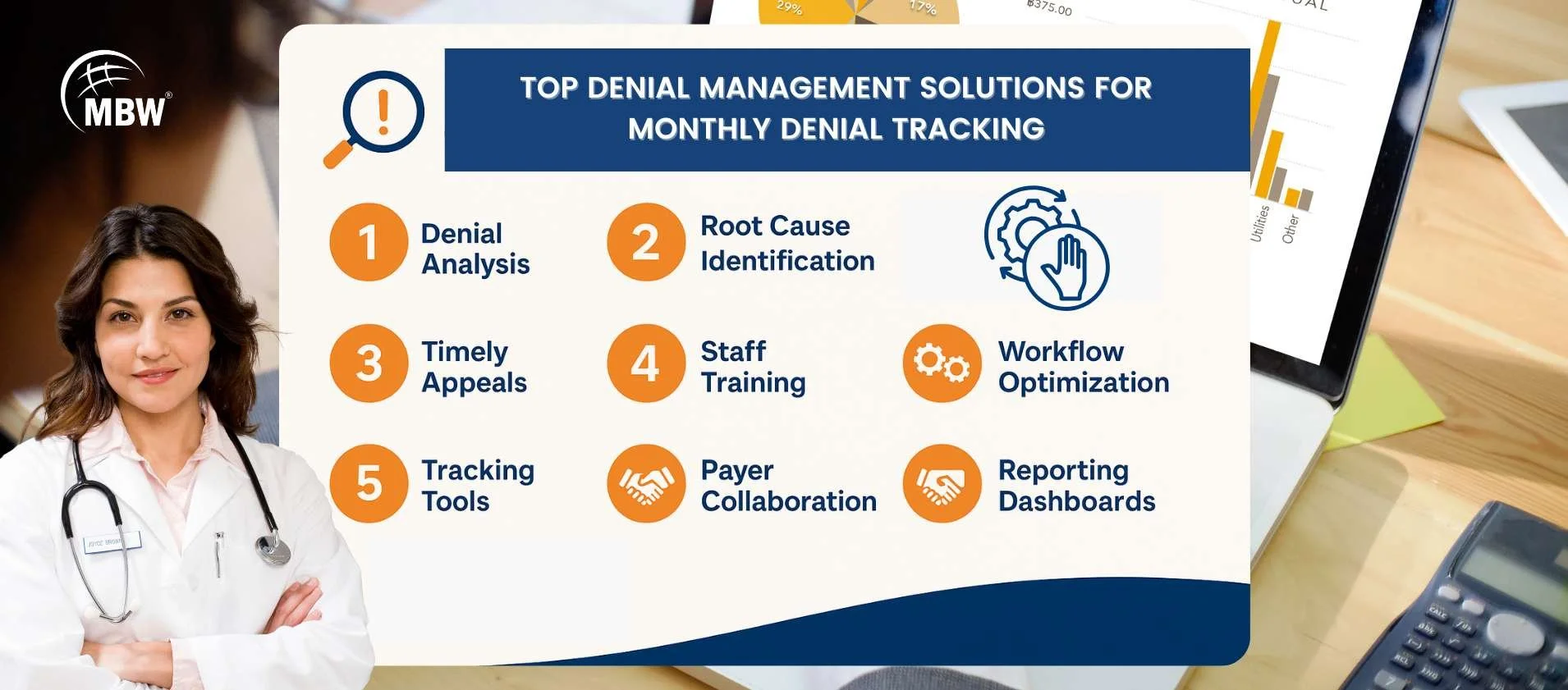
Effectively tracking monthly denial reasons is key to preventing revenue loss and improving claim workflows. These top denial management solutions help healthcare teams identify and resolve denials proactively.
-
Maintain a Centralized Monthly Denial Reason Log
A centralized denial log is essential for organizing and understanding denial trends on a monthly basis. It should capture key data fields such as denial date, payer, denial code, dollar amount, reason provided, and follow-up action taken. When maintained consistently, this log enables denial pattern recognition, supports timely resolution, and lays the groundwork for accurate denial analytics, reporting, and accountability tracking. Denial Management Solutions often include tools for automating and centralizing this log. For more insights on creating a structured tracking process, read our detailed guide on Denial Management in Healthcare.
2. Categorize Denials by Type (Clinical, Technical, Admin)
As a matter of fact, organizing denials by type—clinical, technical, and administrative—helps in streamlining follow-up responsibilities. For instance, clinical denials may go to coders, while administrative errors fall to front-desk or billing staff. This clarity supports accountability. This clarity supports accountability and enhances the effectiveness of Denial Management Solutions.
3. Build Custom Denial Reason Tags
To put it another way, predefined denial categories may not always capture the nuances of specific claims. By applying internal tags like “intake error,” “payer delay,” or “documentation incomplete,” teams gain deeper insights into internal workflow issues. Advanced Denial Management Solutions support this level of customization for better analysis.
4. Identify and Track Top 5 Denial Reasons Monthly
Every month, extract and rank the five most frequent denial reasons. If done consistently, this tactic reveals emerging trends. As a result, these trends can guide staff training and claims processing improvements.
5. Review Denials by Payer Monthly
Payers differ in rules and denial tendencies. By reviewing denials payer-wise, providers can build customized submission and follow-up tactics. Consequently, this improves first-pass claim success and reduces backlogs. Denial Management Solutions often include payer-specific dashboards to assist in this process.
6. Track Appeals Activity and Outcomes
Tracking appeal volume, resolution time, and success rates provides visibility into the effectiveness of denial recovery. Moreover, this practice helps teams decide whether to invest effort into appeals or refile claims. Denial Management Solutions provide appeal tracking modules that support detailed performance metrics. For a detailed approach to managing appeals within RCM, see how it’s done in Mastering Denial Management in Healthcare.
7. Use Monthly Denial Dashboards with Visual Trends
Visualizing denial data through bar charts, heatmaps, or line graphs allows stakeholders to quickly grasp where denials are increasing or improving. As shown above, dashboard insights aid in data-driven discussions and goal-setting.
8. Automate Monthly Denial Summary Reports
By automating denial reporting, teams save time and reduce the chance of missing critical data. Denial Management Solutions that push automated reports via email or internal platforms keep decision-makers informed and aligned.
9. Set Monthly Denial KPIs and Benchmarks
Establish monthly benchmarks such as denial rate, recovery rate, average time to resolve, and appeal turnaround. When tracked month-to-month, these KPIs provide a measurable way to gauge progress. Denial Management Solutions help standardize these indicators.
10. Implement Monthly Denial Threshold Alerts
Configure alerts within your denial management software to trigger notifications when specific denial types cross predefined volume limits. For example, if CO-16 exceeds 50 instances, the system should notify relevant personnel immediately.
11. Assign Denial Ownership to Teams
Assigning denial categories to the appropriate teams—such as front-end, coding, billing, or authorization—ensures accountability and speeds up resolution. Clear ownership promotes a more coordinated workflow and minimizes delays. See how we did it in a real-world case study that highlights effective denial service recovery in action.
12. Conduct Monthly Root Cause Analysis Sessions
Denials are often symptoms of deeper workflow or training problems. Monthly RCA sessions should focus on high-volume or high-impact denials, tracing the origin and identifying process improvements.
13. Compare Denial Performance Month-over-Month
Tracking performance metrics across several months highlights improvement areas and regression points. For example, a drop in eligibility-related denials may indicate effective training, while a spike in documentation errors may signal the need for auditing.
14. Integrate Denial Data With Revenue Reports
To clarify, denial trends should not exist in isolation from revenue reporting. By linking denial data with financial performance metrics such as collections, write-offs, and aging reports, organizations gain a more holistic view of revenue cycle health. This integration ensures that denial patterns are not only tracked but also evaluated for financial impact.
Why it works: Shows how denial categories directly tie into financial exposure and revenue leakage.
15. Use Denial Reason Heatmaps by Department
Heatmaps that segment denials by department (e.g., radiology, surgery, front desk) or location (e.g., clinic vs. hospital) help pinpoint operational weaknesses. For example, if one location shows a higher rate of eligibility denials, targeted staff training can be implemented. This visualization adds a geographical or departmental lens to monthly denial tracking and enables more strategic interventions.
What Happens When You Stop Tracking Denials Monthly?
To summarize, neglecting monthly denial tracking can result in repeat issues going unnoticed, delayed reimbursements, and increased operational inefficiency. Without structured denial management services in place, these problems often persist longer than necessary. Denials become harder to reverse the longer they go unresolved. Therefore, consistent tracking supported by reliable denial management services isn’t optional—it’s integral to revenue integrity and strategic operations.
Consistent monthly denial tracking helps teams act quickly, reduce delays, and improve claim outcomes. At MBW RCM, we support providers in implementing practical solutions that make denial management more effective. Start applying these strategies to identify recurring issues early and stay ahead of preventable denials.
Want help refining your denial tracking process? Talk to our RCM experts today.