

Medical Billing for Cardiovascular coding go beyond basic charge entry. It requires in-depth knowledge of time-based services, procedure bundling, CPT modifiers, and compliance with evolving payer rules.

Accordingly, this 2025 guide walks you through CPT and ICD-10 updates, billing workflow insights, coding pitfalls, and why practices are outsourcing cardiology billing services as part of their broader cardiology billing solutions strategy.
What Is Cardiology Medical Billing and Coding in 2025?
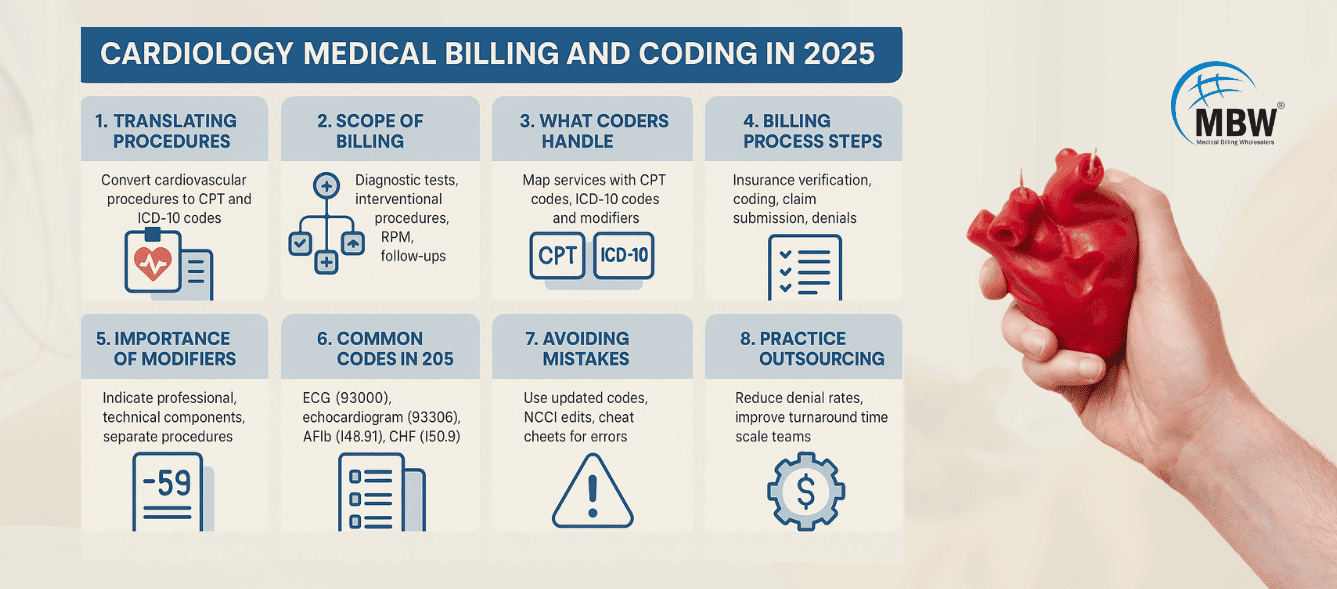
Cardiology medical billing and coding in 2025 refer to translating cardiovascular procedures into CPT and ICD-10 codes that comply with payer-specific policies. If done right, this process drives reimbursements. If done wrong, it leads to denials and delays.
Scope of Cardiology Billing
Cardiology billing services cover a wide range of procedures including:
• Diagnostic tests (e.g., ECG, echo, stress testing)
• Interventional procedures (e.g., stents, pacemakers)
• Remote patient monitoring (RPM)
• Follow-up and post-op visits
What Coders Handle Daily:
Cardiology coders must map services precisely with:
• CPT codes for the procedure
• ICD-10 codes for the diagnosis
• Modifiers for the technical or professional components
When these elements align, cardiology medical billing becomes more reliable and revenue-generating. This reinforces the growing need for accurate cardiology medical billing and coding practices.
How Does the Cardiovascular Medical Billing Process
The Cardiovascular Medical Billing Process involves several critical steps—each one shaping the outcome of reimbursements. Even a single oversight in this chain can trigger underpayments or rejections. That’s why structured cardiology medical billing and coding workflows have become a core operational priority. A key part of this structure includes adhering to well-defined procedures for specific services—for instance, applying echocardiography billing best practices can improve billing accuracy and help prevent claim denials.
Key Steps in the Cardiology Billing Process
-
Step 1: Insurance Verification
Before appointments, verify coverage and authorization requirements. -
Step 2: Clinical Documentation
During the visit, the provider documents services rendered in detail. -
Step 3: Medical Coding
Coders assign cardiology medical coding using CPT and ICD-10 codes based on documentation. -
Step 4: Claim Submission
Claims are submitted electronically with correct modifiers and NPI identifiers. -
Step 5: Payment Posting and Denials
Payments are posted, and denied claims are followed up with appeals if necessary.
Why Modifiers Are Crucial in Cardiology
• Modifier -26: For the professional component
• Modifier -TC: For the technical component
• Modifier -59: To show separate procedures
Without these, claims may be bundled or rejected outright.
What Are the Most Common 2025 Cardiology CPT and ICD-10 Codes?
In 2025, key cardiology CPT codes include 93000 (ECG), 93306 (echo), and 93458 (cath). These codes drive over 60% of cardiology medical billing reimbursements, according to CMS trends. Common ICD-10 codes like I10 (hypertension) and I48.91 (AFib) must support billed procedures. Payers are flagging mismatched CPT-ICD pairs, causing up to 30% denials. Coders must align services and diagnoses carefully, using updated guidelines to improve claim accuracy and minimize reimbursement delays for cardiology billing solutions. Exploring value-based care in cardiology billing offers a practical approach to improving claim outcomes and overall revenue performance.
Choosing the right CPT and ICD-10 codes impacts claim approval and provider reimbursements. Here’s what cardiologists should keep in mind for 2025.
Common Cardiology CPT Codes in 2025
ICD-10 Codes for Frequent Cardiology Diagnoses
Cardiology medical billing and coding teams are now adapting to include remote monitoring, device interpretation, and chronic care management services. Additionally, ICD-10 updates reflect more granular classifications for heart rhythm disorders and cardiac events.
How to Improve Medical Billing for Cardiovascular and Coding for Higher Reimbursements?
To improve reimbursements, Medical Billing for Cardiovascular companies must emphasize documentation. The 2023 MGMA report found 42% of cardiology denials link to missing documentation or modifier errors. Coders should focus on correct CPT-ICD mapping, track denial trends, and use charge-capture tools. Cardiology billing solutions that include audit checklists and real-time coding tools report 20% faster payouts. Regular coder-provider collaboration is also key to reducing claim issues and improving revenue cycle management for cardiology practices.
“The only thing more complex than a stent placement is coding it wrong.”
This shows why successful practices treat cardiology medical billing and coding not as an afterthought, but a revenue-generating function.
What Mistakes Should Be Avoided in Cardiology Coding?
Some coding errors seem small but result in large revenue loss or compliance risk. These common errors are still seen in cardiology medical billing audits. For practices looking to avoid these costly mistakes, it’s essential to implement effective cardiology billing solutions that ensure accuracy and compliance throughout the revenue cycle.
Frequently Seen Errors:
• Using outdated CPT codes
• Incorrect global period billing
• Missing components in split billing scenarios
• Misusing add-on codes or modifiers
Tips to Avoid Mistakes:
• Stay updated with quarterly CPT/ICD changes
• Use NCCI edits to avoid unbundling errors
• Always use cheat sheets for repetitive procedures
Audit reports show that structured cardiology medical billing and coding protocols can significantly reduce these errors across large practice groups.
Why Are More Practices Outsourcing Cardiovascular Medical Billing Services?
Outsourcing is no longer limited to large groups. Even solo cardiologists are now outsourcing to reduce denial rates and improve turnaround time. In fact, many are turning to specialized cardiology medical billing services to optimize their revenue cycle and focus more on patient care.
Why Outsourcing Works for Cardiology
-
Dedicated cardiology medical billing companies
-
Real-time claim scrubbing tools
-
Audit trails to track documentation errors
Comparison: In-House vs Outsourced Cardiology Billing
Practices that outsource cardiology billing gain immediate access to scalable teams and advanced tools—an increasingly popular choice as cardiology medical billing and coding grows more complex.
“ICD codes aren’t just numbers—they’re the difference between a paid claim and a denial.”
How Does Revenue Cycle Management Work for Cardiology Practices?
Revenue cycle management for cardiology includes all back-office tasks from registration to collections. Each component is tied to the billing process.
RCM Workflow Breakdown
-
Before Visit: Schedule + insurance check
-
During Visit: Capture services rendered
-
After Visit: Coding, billing, payment posting
Software Tools That Help
Modern cardiology billing solutions now come equipped with:
-
Real-time eligibility checks
-
Modifier and bundling alerts
-
Rejection pattern recognition dashboards
Cardiology Billing and Coding Cheat Sheet for 2025
Need a go-to reference to speed up coding? This quick-access cheat sheet contains the most frequently used CPT and ICD-10 codes for cardiology medical coding in 2025.
-
93000: ECG with interp
-
93306: Echo complete
-
93015: Stress testing
-
I48.91: Atrial fibrillation
-
I50.9: CHF unspecified
-
I21.9: Acute MI
If you work with cardiology billing in any way, this cheat sheet is a handy resource for anyone dealing with cardiology medical billing and coding.
Getting cardiology medical billing and coding requires more than familiarity with codes—it demands strategic alignment between documentation, compliance, and reimbursement protocols. As cardiology procedures grow in complexity, so do payer expectations. Practices that prioritize coding precision, modifier usage, and denial analytics are positioned to recover more revenue—faster.
Looking to improve claim approvals and reduce denials? Let our cardiology billing experts show you how.
Contact us today or explore our specialized Cardiology Billing Services to see how we can support your growth.
Request for Information Billing for Cardiovascular Coding
Get your cardiovascular billing right the first time! Fill out the form and connect with our coding experts to make the process stress-free. Whether you’re navigating complex procedures or optimizing reimbursements, our specialists are here to guide you every step of the way. Let us help you streamline your coding for accuracy and efficiency!