

Credit Balance Resolution in healthcare RCM focuses on identifying and clearing excess payments through structured workflows and timely actions. Industry data shows that nearly 3–5% of total accounts receivable includes credit balances, and delays beyond 30–45 days can increase audit risk and payer disputes.
Unresolved balances often result from duplicate payments, payer errors, or coordination of benefits issues. This guide explains practical best practices—from system identification and ERA analysis to automation and reconciliation—to help manage balances efficiently and maintain control across RCM operations.
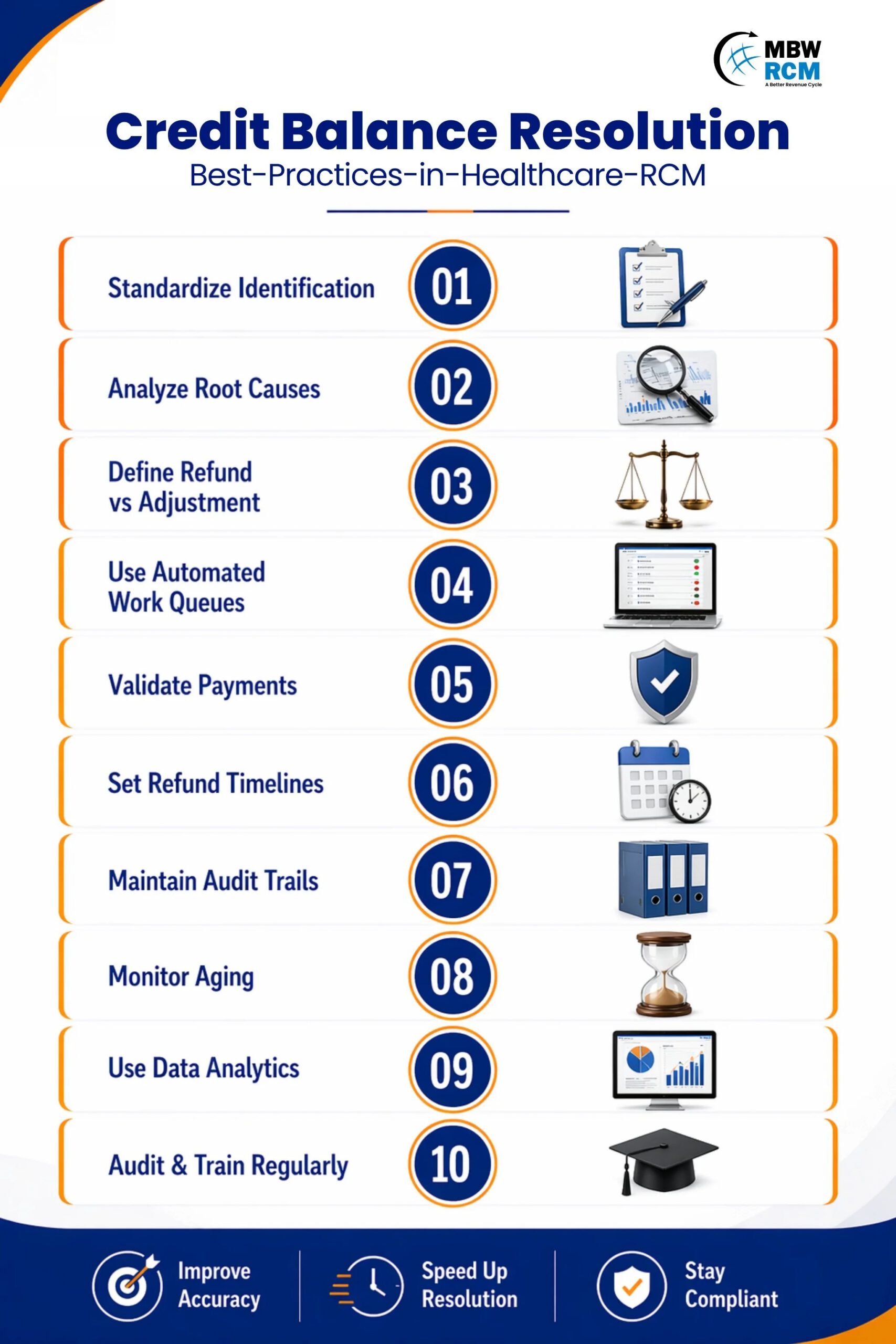
1. Standardize Credit Identification Logic Across Billing Systems
Billing systems must follow consistent rules to detect overpayments across all departments. When systems apply different logic, duplicate or missed balances increase. Clear thresholds, aligned mapping, and validation rules help maintain consistency.
-
Set detection thresholds like >$5 variance or 1% of claim value
-
Align charge, payment, and adjustment mapping across systems
-
Configure validation rules to flag excess payments
This approach reduces manual errors and creates a stable foundation for balance management.
2. Perform Root Cause Analysis Using ERA & Remittance Data
ERA and remittance data provide direct insight into why excess balances occur. CARC and RARC codes reveal payer actions such as overpayments, reversals, or coordination of benefits issues.
Tracking these patterns highlights repeat issues across payers. Organizations that analyze these trends regularly see fewer recurring balances and stronger Credit Balance Resolution performance over time.
3. Implement a Structured Refund vs Adjustment Decision Matrix
Clear decision rules help determine whether a balance should be refunded or adjusted. Payer contracts often define these actions, while patient payments follow separate timelines and handling rules.
-
Define refund vs adjustment criteria based on contracts
-
Separate patient and insurance workflows
-
Apply thresholds for small balance write-offs
Well-defined decisions reduce credit balance risks in healthcare RCM and keep processes compliant.
4. Integrate Automated Work Queues for Balance Segmentation
Automation-driven work queues help segment and assign credit balances using system rules. This reduces manual effort and improves control over aging and compliance timelines.
-
Categorize Accounts by Aging Buckets
Aging segmentation uses fields like posting or last activity date to group accounts into 0–30, 31–60, and >90 days. Accounts beyond 60 days are flagged, while those over 90 days move to escalation queues for priority handling.
-
Assign Work Based on Complexity
Queue logic assigns accounts based on balance amount, payer type, and transaction history. High-value or complex cases go to senior staff, while routine balances follow standard workflows to reduce delays.
-
Apply Priority-Based Routing
System triggers based on refund deadlines and payer rules flag urgent accounts. Balances nearing 30–45 day limits move to high-priority queues, improving visibility and reducing compliance risks.
“Chaos in spreadsheets turns into order when systems start thinking faster than humans.”
5. Validate Payments Through Multi-Level Reconciliation Checks
Payment validation confirms that posted amounts match claims, charges, and payer responses. Teams compare ERA, EOB, and billing records to identify duplicate or incorrect transactions.
This step prevents incorrect refunds and reduces rework. Consistent validation improves the reliability of Credit Balance Resolution and supports accurate account handling.
6. Establish Refund Processing Protocols with Defined Timelines
Refund timelines must align with payer rules and regulatory expectations. Delays often affect both compliance and patient satisfaction.
-
Set refund timelines such as 30–45 days
-
Track refund stages through system logs
-
Require approvals for high-value refunds
Timely processing directly impacts credit balance impact on patient experience, especially in patient overpayment cases.
7. Maintain Comprehensive Audit Trails for Every Transaction
Audit trails capture all account-level actions, providing traceability and compliance visibility across transactions.
-
Record Transaction History
Each interaction must be recorded with user ID, action type, date-time stamp, and activity notes. This includes payment postings, adjustments, refunds, and reversals, along with any claim data changes.
-
Store Supporting Documents
All supporting files such as EOBs, ERA reports, refund approvals, and payer communications should be stored and retained for 5–7 years based on compliance requirements.
-
Enable Audit Reporting
Audit-ready reports should include transaction summaries, aging details, and action history, allowing quick response to audits and payer reviews.
“When audits arrive, memory fails—but documentation never does.”
8. Monitor Aging and Escalate Delayed Accounts Systematically
Aging accounts require close tracking to prevent accumulation. Balances older than 60 or 90 days often carry higher compliance risk. Escalation protocols help route delayed cases to senior teams.
Prioritizing high-value accounts reduces exposure and helps teams improve Credit Balance in Healthcare operations without delays.
9. Use Data Analytics to Identify Trends and Process Gaps
Data analytics in RCM helps uncover patterns behind overpayments and workflow inefficiencies, allowing teams to take corrective action based on real transaction data.
-
Analyze Payer Trends
Segment data by payer ID, claim type, and denial codes to identify payers contributing to overpayments or discrepancies. This helps detect recurring issues like incorrect reimbursements.
-
Generate Predictive Reports
Use historical data and variables such as payment variance and claim frequency to identify accounts likely to develop balances, enabling early action.
-
Identify Process Gaps
Analytics highlights inefficiencies such as delayed postings or incorrect adjustments, helping teams refine workflows and reduce errors.
Organizations using analytics report nearly 20–25% faster resolution cycles, improving overall efficiency.
10. Conduct Periodic Process Audits and Staff Training
Regular audits help identify workflow gaps and improve consistency across teams. Staff training ensures awareness of payer rules, system updates, and compliance requirements. Continuous feedback loops allow teams to refine processes over time.
This approach strengthens Credit Balance Resolution and keeps operations aligned with current standards. If you are interested to read more about credit balances please have a look at this blog on ”Resolving Credit Balance Conundrum”
Benefits of These Best Practices in Credit Balance Resolution
Applying these best practices brings measurable improvements across workflows, helping teams manage balances with better control and consistency.
-
Maintains consistency across billing systems and processes
-
Improves coordination between teams and workflows
-
Provides better visibility into account-level activities
-
Supports structured and timely decision-making
-
Strengthens control over high-risk and high-value accounts
-
Improves overall workflow transparency
-
Helps maintain steady and predictable processing cycles
Want a better understanding of the process? Check out our Step-by-Step to Resolving Credit Balances guide to see how these best practices can be applied effectively across workflows.
Conclusion
Effective Credit Balance Resolution relies on structured workflows, validation checks, and ongoing monitoring to manage excess payments without delays. Standardized processes and automation help reduce compliance risks, limit rework, and maintain control over account balances.
For anyone looking to improve results, expert Credit Balance Services can support faster resolution and better efficiency. Contact MBW RCM today to strengthen your credit balance processes.
Connect with Our Specialists
Identify overpayment issues, reconciliation gaps, and refund delays with a review of your current RCM workflows. Our team evaluates credit balance identification, ERA analysis, reconciliation processes, and refund handling to highlight areas that may impact balance management and compliance.
Fill out the form to connect with our specialists and learn how our credit balance services can help streamline workflows, reduce aging backlogs, and support consistent balance resolution.