

Healthcare revenue cycles increasingly face delays due to unresolved overpayments, mismatched remittances, and slow refund approvals across payer workflows. These inefficiencies often lead to aging credit balances, impacting cash flow, compliance readiness, and Days in A/R.
With high-volume ERA, EFT, and claim-level adjustments, even minor gaps in reconciliation or approval logic can extend refund cycles to 30–90 days. Faster refund processing depends on structured automation, real-time validation, and streamlined payer workflows.
This blog highlights practical, high-impact methods to improve refund speed and strengthen Credit Balance Services in Healthcare performance across the revenue cycle.
1. Automate Negative Balance Work Queues
Manual refund identification increases unresolved overpayment aging and delays refund processing. Many healthcare facilities still rely on periodic account reviews, causing refund-required balances to remain open for 30–60 days.
Advanced billing systems use automated negative balance work queues that trigger when:
-
Account balances become negative
-
Duplicate EFT payments are posted
-
Payment exceeds contracted reimbursement
-
Voided charges create overpayments
These triggers automatically route accounts for refund validation based on payer type, balance amount, and aging priority. Automated work queue logic can reduce refund identification time by nearly 40% within Credit Balance Services in Healthcare workflows.
2. Perform Daily ERA and EFT Reconciliation
Delayed ERA and EFT reconciliation remains one of the primary causes of aging healthcare credit balances. Many facilities reconcile:
-
ERA files
-
EFT deposits
-
Bank transactions
only on a weekly or monthly basis, delaying overpayment detection and refund validation.
Advanced RCM operations perform daily:
-
ERA auto-post validation
-
EFT-to-bank matching
-
Allowed amount verification
-
Variance reconciliation
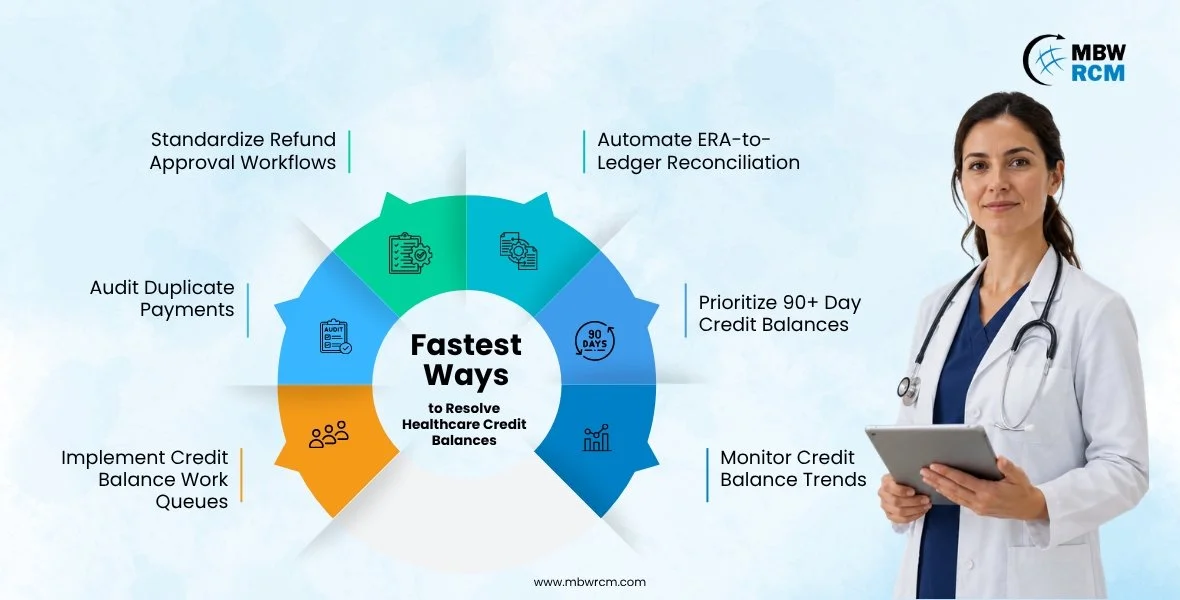
This process quickly identifies duplicate reimbursements, incorrect payment posting, COB-related overpayments, and excess insurance payments before balances enter aging cycles. Daily reconciliation workflows can reduce refund detection timelines from several weeks to less than 24 hours, supporting Faster Credit Resolution in Healthcare and improving payment accuracy across high-volume reimbursement operations.
3. Use CARC and RARC Mapping for Refund Detection
Manual remittance review slows refund processing and increases adjustment posting errors. Modern billing platforms use automated CARC and RARC mapping logic to identify duplicate payments, recoupment transactions, reversal adjustments, and refund-required claims directly from ERA data.
Integrated mapping engines automatically categorize overpayments based on payer adjustment behavior and payment variance logic, reducing manual reconciliation dependency. Automated code mapping improves refund accuracy, lowers unresolved credit balances, and accelerates escalation workflows within Credit Balance Services in Healthcare operations.
4. Prioritize Medicare and High-Dollar Credits
Not all healthcare credit balances require the same level of priority. Medicare overpayments, duplicate reimbursements, and high-value payer credits require faster validation workflows to reduce compliance risk and refund aging.
-
Identify Medicare Credits Before Filing Deadlines
Medicare overpayments nearing filing limits require immediate refund validation to avoid CMS repayment violations, compliance scrutiny, and audit escalations. Delayed Medicare refunds can increase repayment penalties and regulatory exposure across revenue cycle operations.
-
Fast-Track High-Dollar Credit Balances
High-value payer credits should move through accelerated workflows because delayed processing increases financial exposure and unresolved refund aging. Priority-based routing helps reduce backlog accumulation in large-value reimbursement accounts.
-
Detect Duplicate Medicare and Commercial Payments
Duplicate Medicare and commercial reimbursements require priority review to reduce overpayment risk and improve Healthcare Credit Balance Resolution workflows. Automated duplicate payment detection improves refund accuracy and accelerates reconciliation timelines.
5. Create Payer-Specific Refund Workflows
Every payer follows different refund submission procedures, documentation standards, and recoupment requirements. Manual payer verification increases refund turnaround time and reconciliation delays across healthcare reimbursement workflows.
Modern payer-specific refund automation follows structured workflows such as:
Refund Identification
↓
Payer Rule Validation
↓
Refund Form Selection
↓
EFT Reversal or Recoupment Processing
↓
Timely Filing Verification
↓
Refund Submission and Tracking
Automated payer workflow configuration improves claim-level reconciliation accuracy, reduces refund rejection rates, and accelerates refund processing consistency across Credit Balance Services in Healthcare operations. Payer-specific automation can improve refund processing consistency by nearly 25%.
6. Link Denial Reprocessing With Refund Workflows
A large percentage of healthcare credit balances originate after:
-
Corrected claim submissions
-
Denial reversals
-
Retroactive payer adjustments
-
Claim reprocessing events
Disconnected denial management and refund workflows delay overpayment identification and create duplicate manual review processes.
Integrated RCM systems automatically trigger refund validation once:
-
A denied claim is reprocessed
-
Payment variance exceeds contracted reimbursement
-
Adjustment reversals create negative balances
This integration improves workflow continuity and reduces refund processing lag across the revenue cycle.
7. Use AI for Duplicate Payment Detection
AI-powered analytics platforms accelerate refund processing by identifying duplicate reimbursements and payment variances before balances enter extended aging cycles.
-
Detect Duplicate EFT and ERA Payments Faster
AI models analyze duplicate EFT trace IDs, repeated claim payments, matching CPT-level reimbursements, and recurring payment amounts directly from ERA and EFT data. This helps identify overpayments immediately after payment posting.
-
Prioritize High-Risk Overpayment Accounts
Predictive refund scoring automatically flags high-risk accounts based on payer behavior patterns, adjustment inconsistencies, and payment variance thresholds. This reduces manual review delays and accelerates refund validation workflows.
-
Reduce Refund Aging With Automated AI Analysis
AI-driven payment variance analysis improves duplicate payment detection speed by up to 35% and reduces unresolved overpayment aging. This helps Improve Healthcare Credit Resolution Efficiency across high-volume reimbursement operations.
8. Automate Refund Approval Processes
Refund approvals often become a major delay point in credit balance resolution due to multiple handoffs and manual verification steps across departments.
Manual refund approval chains often create operational delays between:
-
Billing departments
-
Finance teams
-
Compliance officers
-
Revenue cycle leadership
Advanced healthcare providers now implement automated approval workflows using:
-
Role-based authorization
-
Auto-approval thresholds
-
Escalation routing
-
Electronic audit tracking
Digital approval systems reduce dependency on email approvals and fragmented communication processes.
Organizations using workflow automation frequently reduce refund approval turnaround times from 10–15 business days to less than 72 hours.
9. Track Credit Balance Aging in Real Time
Without real-time visibility, unresolved refund accounts continue aging unnoticed.
Modern RCM analytics platforms track:
-
Credit balance aging days
-
Refund turnaround metrics
-
Approval lag intervals
-
Payer-wise refund trends
-
Refund backlog percentages
Real-time dashboards allow revenue cycle leaders to identify workflow bottlenecks immediately and prevent large-scale credit accumulation.
Data-driven monitoring has become a critical operational component of modern Credit Balance Services in Healthcare because it improves accountability, escalation speed, and refund cycle transparency.
10. Outsource Aged Credit Balance Accounts
Aging credit balances often persist when internal workflows are overloaded with unresolved A/R, delayed payer responses, and fragmented reconciliation processes, leading to increased refund turnaround time.
The below are the primary drivers of delayed credit balance resolution and refund backlog accumulation.
Large hospitals and multi-specialty healthcare systems frequently struggle with:
-
Legacy A/R balances
-
High-volume refund backlogs
-
Staffing shortages
-
Multi-location reconciliation complexity
Outsourcing aged healthcare credit balances to specialized RCM partners accelerates:
-
Refund validation
-
Account cleanup
-
Payer communication
-
Refund issuance timelines
Most organizations outsource credits aged beyond 90 days to improve recovery efficiency and reduce unresolved refund exposure.
Dedicated refund specialists provide scalable operational support, payer expertise, and faster reconciliation workflows that internal billing teams may not sustain consistently.
Key Technologies Used for Faster Credit Balance Refunds
Technology-driven automation is now central to modern refund management strategies.
Healthcare organizations increasingly rely on:
-
ERA auto-posting systems
-
AI-based payment variance analytics
-
Credit balance workflow engines
-
EFT reconciliation software
-
Automated refund approval platforms
-
Real-time RCM dashboards
-
Predictive overpayment detection tools
These technologies reduce manual intervention, improve payment accuracy, strengthen compliance tracking, and accelerate refund turnaround cycles across healthcare revenue cycle operations.
As payer reimbursement complexity continues to increase, healthcare providers must adopt automation-focused Credit Balance Services in Healthcare strategies to maintain operational efficiency, regulatory compliance, and financial stability.
Conclusion:
Efficient refund processing in healthcare depends on eliminating delays in credit balance detection, reconciliation, and approval workflows. When automation, payer-specific logic, and real-time analytics work together, organizations can significantly reduce aging refunds, improve cash flow, and strengthen compliance accuracy across the revenue cycle.
To streamline your Credit Balance Services in Healthcare and accelerate refund recovery, Contact Us today to optimize workflows and improve financial performance with scalable, technology-driven solutions.
Want to Speed Up Credit Balance Refunds?
Delayed credit balance resolution can increase refund backlogs, payer disputes, reconciliation gaps, and compliance risks across healthcare billing operations. Aging credits, duplicate payments, ERA posting mismatches, and unresolved overpayments often slow refund processing and impact revenue workflows.
Fill out the form below to connect with our specialists and improve credit balance resolution, reduce refund delays, and strengthen your healthcare billing workflows.