
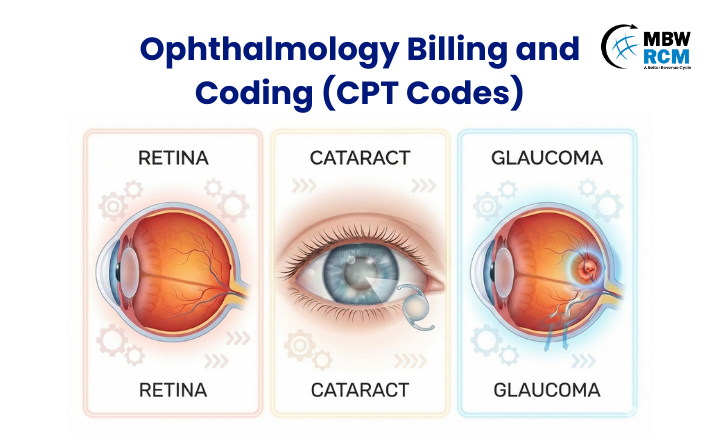
Ophthalmology billing and coding require a high level of precision, especially for retina, cataract, and glaucoma services where diagnostic testing, surgical procedures, and global periods intersect. Frequent payer reviews, evolving coding guidelines, and ophthalmic documentation standards make compliant claim submission challenging.
This blog breaks down essential considerations for retina, cataract, and glaucoma services, helping practices submit clean claims, maintain compliance, and achieve consistent reimbursement.
Importance of Effective Billing and Coding in Ophthalmology
Ophthalmology practices deliver a blend of medical management, diagnostic testing, and surgical care, each governed by unique coding and billing rules. Errors can result in:
-
Claim denials and payment delays
-
Underbilling or revenue leakage
-
Increased audit risk and compliance penalties
A strong understanding of CPT coding, modifier usage, global periods, and documentation standards is essential for clean claims and optimized reimbursement.
Billing and Coding for Retina Services
Retina services involve advanced diagnostics, injections, laser treatments, and complex surgeries. Correct coding and billing depend heavily on medical necessity and interpretation reports.
Common Retina CPT Codes
Procedures
-
67028 – Intravitreal injection
-
67210 – Focal laser photocoagulation
-
67220 – Panretinal photocoagulation
-
67036 – Pars plana vitrectomy
-
67108 – Repair of retinal detachment
Diagnostic Testing
-
92134 – OCT, retina
-
92250 – Fundus photography
-
92235 – Fluorescein angiography
Each diagnostic test must include a separate physician interpretation and report to be billable.
Billing Considerations for Retina Services
-
Link CPT codes with appropriate ICD-10 diagnoses such as diabetic retinopathy, macular edema, or age-related macular degeneration
-
Use modifiers -26 (professional) or -TC (technical) when billing split services
-
Do not unbundle diagnostic tests or procedures included in a global surgical package
-
Intravitreal injections require drug billing (J-codes) and accurate units documentation
Key Billing Tip: Diagnostic testing should not be performed at every visit unless disease progression or medical necessity is clearly documented.
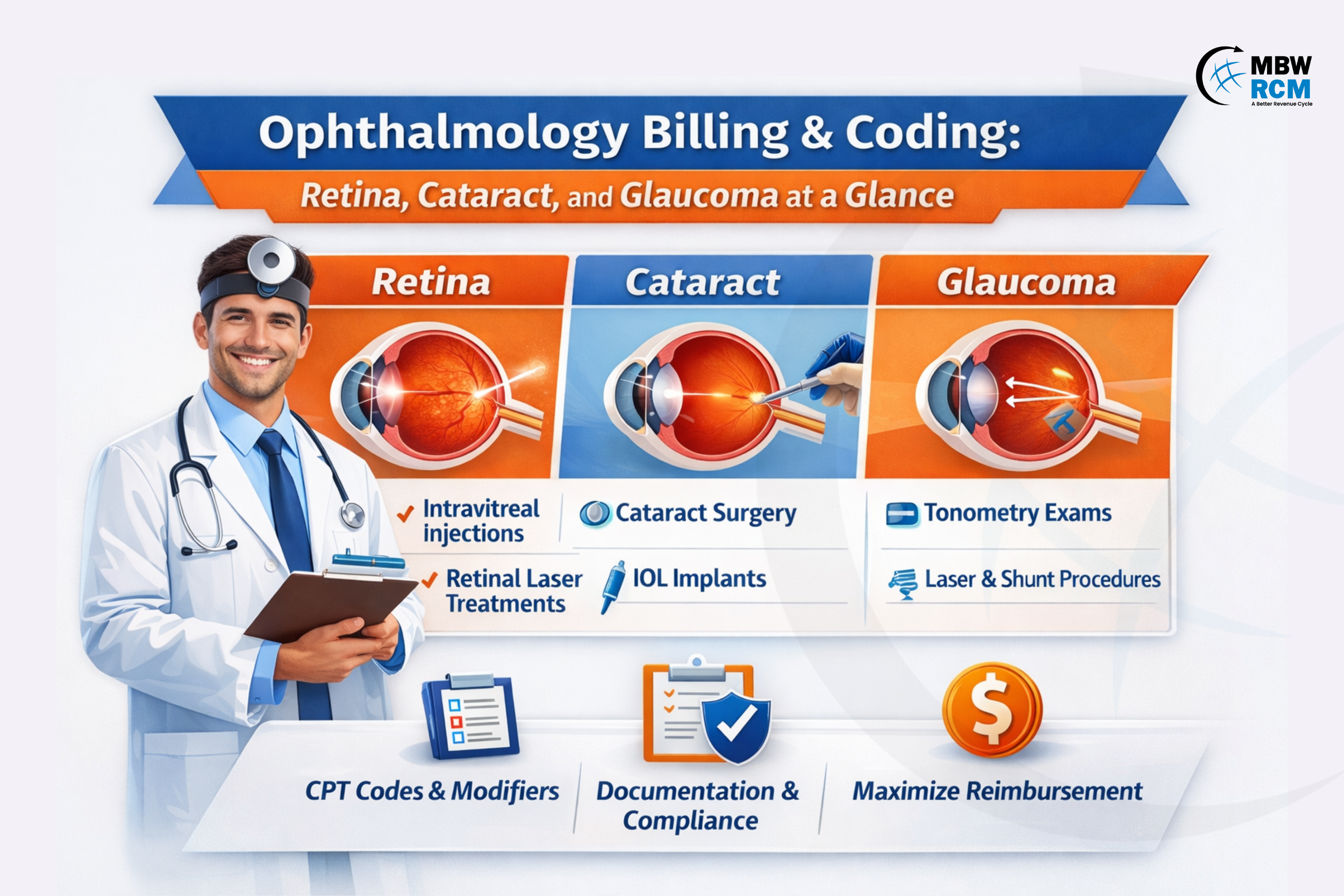
Billing and Coding for Cataract Services
Effective billing and coding for cataract services depend on proper CPT code selection based on surgical technique and complexity, not the type of intraocular lens used. Clear documentation is required to support medical necessity and compliant reimbursement.
Cataract Surgery CPT Codes
-
66984 – Routine cataract extraction with intraocular lens (IOL) insertion
-
66982 – Complex cataract surgery
Use 66982 only when documentation supports surgical complexity, such as:
-
Dense or mature cataracts
-
Zonular instability
-
Use of capsular tension rings
-
Prior ocular trauma or surgery
Other procedures performed in cataract care include:
-
66821 – Laser capsulotomy (YAG capsulotomy for posterior capsular opacification)
-
66830 – Removal of secondary membranous cataract (incisional technique)
-
66840 – Removal of lens material by aspiration
-
66983 – Intracapsular cataract extraction with IOL insertion (rarely performed)
Types of Cataract IOLs (Does Not Change CPT Code):
-
Standard monofocal IOL
-
Premium IOLs (toric or multifocal)
Billing Guidelines for Cataract Services
-
Cataract surgery carries a 90-day global period
-
Pre-op and routine post-op visits are bundled into the surgical reimbursement
-
Use modifier -24 only for unrelated E/M visits during the global period
-
Surgery must meet medical necessity criteria, including documented visual impairment affecting daily activities
Billing and Coding for Glaucoma Services
Glaucoma services involve ongoing disease management supported by diagnostic testing, laser treatments, and surgical interventions. CPT code selection must reflect clinical findings, disease severity, and treatment intent, with documentation clearly supporting medical necessity for each service performed.
Common Glaucoma CPT Codes
Diagnostic Testing
-
92083 – Visual field examination (threshold testing)
-
92133 – OCT, optic nerve
-
92250 – Fundus photography
-
76514 – Ophthalmic ultrasound, diagnostic (pachymetry)
Laser Procedures
-
65855 – Laser trabeculoplasty (SLT/LTP)
-
66761 – Laser peripheral iridotomy
Surgical Procedures
-
66170 – Trabeculectomy (without scarring)
-
66172 – Trabeculectomy (with scarring or prior surgery)
-
66180 – Aqueous shunt to extraocular reservoir
-
66183 – Insertion of aqueous drainage device without reservoir
-
66989 – Implantation of aqueous drainage device, internal approach (MIGS, without cataract surgery)
-
66991 – Implantation of aqueous drainage device, internal approach (MIGS, with cataract surgery)
Each test or procedure must be tied to disease severity, progression, or treatment planning.
Billing Considerations for Glaucoma Services
-
Clearly document disease stage, progression, or stability
-
Avoid repetitive testing without clinical justification
-
Use modifier -25 when billing an E/M service with a procedure on the same day, ensuring documentation supports a separate, significant evaluation
-
Ensure laterality is documented and coded correctly
Compliance Note: Glaucoma testing is a frequent audit target; overuse without progression documentation can lead to recoupments.
Quick Reference: Retina, Cataract & Glaucoma Billing
Key Modifiers in Retina, Cataract & Glaucoma Billing
Modifiers are essential for reporting distinct services and ensuring accurate reimbursement in ophthalmology billing. Proper use of modifiers helps clarify clinical circumstances, prevent claim denials, and support compliance for retina, cataract, and glaucoma services.
-
Modifier -25 – Used when a significant, separately identifiable E/M service is provided on the same day as a procedure
-
Modifier -24 – Reports an unrelated E/M service during a postoperative global period
-
Modifiers -26 / -TC – Distinguish professional and technical components of diagnostic tests
-
RT / LT – Identify laterality for eye-specific procedures
Clear and complete documentation is critical to support ophthalmic reimbursement and reduce claim denials. Accurate records help demonstrate medical necessity, support CPT code selection, and ensure compliance, especially when Coding for Cataracts and Glaucoma, which are closely reviewed by payers.
Documentation Requirements in Ophthalmology Billing and Coding
Clear and complete documentation supports effective Ophthalmology Billing and Coding, helps demonstrate medical necessity, and reduces claim denials across retina, cataract, and glaucoma services.
Key Documentation Requirements include:
-
Specific ICD-10 diagnosis codes linked to each billed service
-
Laterality clearly documented (right eye, left eye, or bilateral)
-
Description of disease severity, progression, or stability
-
Physician interpretation and signature for all diagnostic tests
-
Justification of surgical complexity when reporting higher-level CPT codes
Want to know more about the Billing & Coding for Posterior Segment Imaging?
Top 7 Ophthalmology Billing Mistakes That Impact Reimbursement
Accurate Ophthalmology Billing and Coding extends beyond selecting the correct CPT code. Small errors throughout the revenue cycle can lead to significant revenue leakage over time.
1. Billing Diagnostic Tests Too Frequently
Repeated OCT, visual field, or fundus photography testing without documented clinical necessity can result in denials and audit exposure.
2. Incorrect Reporting of Complex Cataract Surgery
Using CPT 66982 without sufficient documentation supporting surgical complexity may trigger payer reviews and payment recoupments.
3. Missing Drug Billing for Retina Injections
Intravitreal injections often require separate drug billing using appropriate J-codes and accurate unit reporting.
4. Failure to Link CPT and ICD-10 Codes Correctly
Payers require diagnosis codes that clearly support the medical necessity of the service performed.
5. Unbundling Services Included in Global Packages
Billing separately for services included within a surgical package can lead to compliance concerns and claim denials.
6. Incomplete Documentation of Disease Progression
Glaucoma and retina services frequently require evidence of progression, severity, or treatment planning.
7. Delayed Denial Follow-Up
Failure to address denied claims promptly can increase aging accounts receivable and reduce collection opportunities.
Regular coding audits, physician education, and denial trend analysis can help practices identify these issues before they impact revenue.
Common Ophthalmology Billing Denials and How to Prevent Them
Even well-established ophthalmology practices experience claim denials related to retina, cataract, and glaucoma services. Many denials stem from documentation gaps, coding inaccuracies, or insufficient support for medical necessity.
Some of the most common denial reasons include:
Missing or Insufficient Medical Necessity Documentation
Payers often deny diagnostic tests such as OCT, visual field testing, and fundus photography when documentation does not clearly demonstrate the clinical need for the service.
Prevention Tip: Document disease progression, treatment planning decisions, symptoms, and physician findings that justify the test.
Incorrect Modifier Usage
Improper use of modifiers such as -25, -24, -26, and -TC can result in claim rejections or payment delays.
Prevention Tip: Ensure modifiers accurately reflect the services performed and are supported by clinical documentation.
Global Period Billing Errors
Many ophthalmology practices mistakenly bill postoperative visits that are included within the global surgical package.
Prevention Tip: Verify global period guidelines and use modifier -24 only when the visit is unrelated to the surgical procedure.
Laterality Coding Errors
Failure to accurately report right eye (RT), left eye (LT), or bilateral procedures can trigger denials and payer audits.
Prevention Tip: Implement documentation reviews to ensure laterality is consistently captured throughout the patient record.
Lack of Interpretation Reports
Diagnostic testing often requires a separate physician interpretation and report to support reimbursement.
Prevention Tip: Maintain complete test interpretations and physician signatures within the medical record.
By proactively addressing these issues, ophthalmology practices can reduce denials, improve clean claim rates, and strengthen reimbursement performance.
How Ophthalmology Practices Can Improve Revenue Cycle Performance
Today’s ophthalmology practices face increasing reimbursement pressure, growing documentation requirements, and more frequent payer scrutiny. Strengthening revenue cycle processes can help reduce administrative burden while supporting financial stability.
Strengthen Documentation Quality
Clear clinical documentation supports coding accuracy, medical necessity, and audit readiness across retina, cataract, and glaucoma services.
Monitor Denial Trends
Tracking denial patterns can help identify recurring issues related to coding, authorization, eligibility verification, or documentation deficiencies.
Conduct Routine Coding Audits
Periodic reviews of claims and medical records help uncover compliance risks, missed reimbursement opportunities, and workflow inefficiencies.
Optimize Charge Capture Processes
Ensuring all billable services, procedures, diagnostic tests, and medications are accurately captured can reduce revenue leakage.
Partner with Experienced Ophthalmology Billing Specialists
Specialized ophthalmology billing teams understand payer-specific requirements, coding updates, and reimbursement challenges associated with retina, cataract, and glaucoma services.
A proactive approach to Ophthalmology Billing and Coding helps practices improve clean claim rates, reduce denials, accelerate reimbursements, and create a more predictable revenue cycle.
Tips to Improve Reimbursement in Ophthalmology Practices
Improving reimbursement depends on preventing avoidable billing and administrative errors that delay or reduce payments. Strong Ophthalmology Billing and Coding processes help ensure claims are submitted correctly and paid on time.
Practical tips to improve reimbursement include:
-
Link CPT codes accurately to ICD-10 diagnoses to support medical necessity
-
Review and correct claim edits and denial reasons on a regular basis
-
Verify provider enrollment to avoid ophthalmology NPI/TIN mismatches
-
Apply modifiers correctly and document separately billable services
-
Conduct periodic internal audits to identify and correct recurring issues
Conclusion
Consistent Ophthalmology Billing and Coding depend on precise documentation, correct code selection, and adherence to payer guidelines. Retina, cataract, and glaucoma services involve detailed coding rules that require close attention throughout the billing process. Partnering with an experienced ophthalmology billing services can help practices reduce denials, improve reimbursement, and maintain compliance without increasing administrative workload. Contact MBW RCM today to see how we can support your practice and simplify billing operations.
Request for Information
Fill out the form to learn more about ophthalmology billing and coding for retina, cataract, and glaucoma services. Our specialists review coding workflows, documentation, and claim submission related to ophthalmology procedures.
Get a clearer view of current billing practices, identify gaps affecting claim outcomes, and take informed steps to improve results.