

Understanding the type of service codes for medical billing is essential for accurate claim submission, faster reimbursement, and fewer denials. These codes help translate patient encounters into billable claims that insurance payers can process correctly. Without the right coding structure, providers risk delayed payments, rejected claims, and compliance concerns.
In this guide, we explain the main type of service codes for medical billing, including CPT, HCPCS, ICD-10-CM, Place of Service (POS), and E/M codes. You will also learn how these codes are used in claim submission, what errors to avoid, and how to improve coding accuracy.
Understanding Service Codes for Medical Billing
The type of service codes for medical billing refers to the standardized code sets used to describe healthcare services, procedures, supplies, diagnoses, and care settings. These codes are required for submitting claims to insurance companies and government payers.
Every patient visit involves at least one billable service, and each service must be reported with the correct code. Whether the service is a preventive exam, diagnostic test, treatment, or medical supply, selecting the right type of service codes for medical billing helps ensure claim accuracy and reimbursement.
Accurate coding supports:
-
Clean claim submission
-
Faster insurance processing
-
Fewer denials and rejections
-
Better compliance with payer rules
-
Improved revenue cycle performance
What Are the Main Types of Service Codes for Medical Billing?
There are several major code sets that make up the type of service codes for medical billing. Each one serves a different purpose in documenting and billing healthcare services.
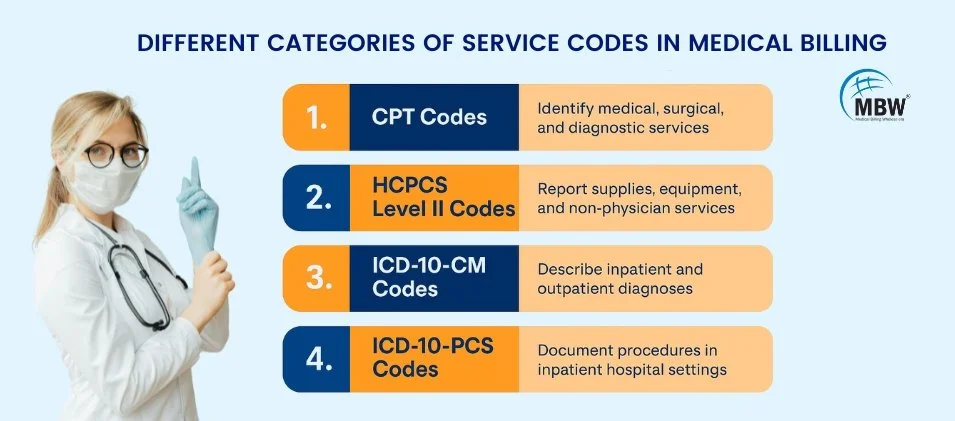
1. CPT Codes
CPT, or Current Procedural Terminology, codes are used to report medical, surgical, and diagnostic procedures performed by physicians and other qualified healthcare professionals. This is one of the most common types of service codes for medical billing because it directly describes the service rendered.
2. HCPCS Level II Codes
HCPCS Level II codes are used for items and services not included in CPT, such as durable medical equipment, ambulance transportation, certain drugs, and medical supplies. These are another important type of service codes for medical billing, especially for Medicare and Medicaid claims.
3. ICD-10-CM Codes
ICD-10-CM codes describe the patient’s diagnosis or condition. While CPT and HCPCS explain what service was provided, ICD-10-CM explains why the service was medically necessary. This makes diagnosis coding a critical type of service codes for medical billing.
4. Place of Service (POS) Codes
POS codes are two-digit codes that identify where the service was performed. Insurance payers use POS codes to determine reimbursement based on the care setting. This is another essential type of service codes for medical billing because an incorrect location code can affect payment.
5. Evaluation and Management (E/M) Codes
E/M codes are a subset of CPT codes used to report office visits, hospital encounters, emergency visits, and similar patient evaluation services. These codes are a highly used type of service codes for medical billing because they reflect visit complexity, provider work, and time.
CPT Codes: A Core Type of Service Codes for Medical Billing
Among every type of service codes for medical billing, CPT codes play the most central role in service-based billing. These five-digit numeric codes describe procedures ranging from routine office visits to major surgeries.
Medical billers rely on CPT codes to show exactly what the provider did during the patient encounter. Without accurate CPT coding, claims may be underpaid, denied, or delayed.
Examples of CPT codes include:
-
99213 – Established patient office visit
-
93000 – Electrocardiogram with interpretation
-
71046 – Chest X-ray, two views
Because CPT is such a foundational type of service codes for medical billing, billers must understand both the code selection rules and documentation requirements.
CPT Modifiers Add More Detail
Modifiers are two-character additions appended to CPT codes to provide extra information about how a service was performed. They help clarify special circumstances and give payers the context they need to process the claim correctly.
Common examples include:
-
-25 – Significant, separately identifiable E/M service on the same day
-
-59 – Distinct procedural service
-
-76 – Repeat procedure by the same provider
When modifiers are missing or used incorrectly, even the right type of service codes for medical billing may still lead to denials or underpayments.
HCPCS Level II Codes for Supplies, Drugs, and Equipment
HCPCS Level II codes are another essential type of service codes for medical billing. They are alphanumeric and used to report services and products not covered under CPT.
These codes are especially common in claims involving:
-
Durable medical equipment
-
Injectable drugs
-
Prosthetics and orthotics
-
Ambulance transport
-
Certain outpatient supplies
Examples include:
-
A0428 – Ambulance service, basic life support
-
E0110 – Underarm crutch
-
J3420 – Vitamin B-12 injection
Correct use of HCPCS codes ensures providers receive payment for non-physician items and services that would otherwise go unreported.
ICD-10-CM Diagnosis Codes in Medical Billing
ICD-10-CM diagnosis codes are a key type of service codes for medical billing because they explain the medical necessity behind the procedure or service. Payers compare diagnosis codes with CPT or HCPCS codes to determine whether the treatment was justified.
For example, if a provider bills for imaging, lab work, or a procedure, the diagnosis code should support why that service was needed. If the diagnosis does not match the procedure, the claim may be denied.
Example:
-
M54.5 – Low back pain
Diagnosis accuracy is critical because even a correctly reported procedure can be rejected if the ICD-10-CM code does not support medical necessity.
Why POS Codes Matter in the Type of Service Codes for Medical Billing
Place of Service codes identify where treatment occurred. This type of service codes for medical billing affects reimbursement because payers assign different rates depending on whether care was delivered in an office, hospital, telehealth setting, or facility.
Common POS codes include:
-
11 – Office
-
21 – Inpatient hospital
-
22 – Outpatient hospital
-
02 – Telehealth provided other than in patient’s home
Using the wrong POS code can result in incorrect payments or claim rejection. That is why POS coding should always match the documented location of care.
What E/M Codes Mean in Medical Billing
E/M codes are a commonly used type of service codes for medical billing tied to patient visits and provider evaluation. These codes are based on factors such as:
-
Whether the patient is new or established
-
Medical decision-making complexity
-
Total provider time spent on the encounter
Common E/M codes include:
-
99202 – New patient, straightforward visit
-
99203 – New patient, low-complexity visit
-
99204 – New patient, moderate-complexity visit
-
99214 – Established patient, moderate-complexity visit
-
99215 – Established patient, high-complexity visit
-
99285 – Emergency department visit, high severity
Accurate E/M selection is important because these codes are closely reviewed by payers and auditors.
How the Type of Service Codes for Medical Billing Are Used in Claim Submission
The type of service codes for medical billing is used together on claim forms such as the CMS-1500 and UB-04. Each code set contributes a different piece of the billing picture.
CPT and HCPCS codes
These show the procedures, services, supplies, or equipment provided.
ICD-10-CM codes
These explain the diagnosis and establish medical necessity.
Modifiers
These clarify special billing situations or service variations.
POS codes
These identify the setting where care occurred.
Together, these code elements create a complete and billable claim. If one part is missing, outdated, or mismatched, the payer may reject or deny the claim.
Claims are often reviewed by clearinghouses and scrubber tools before submission. These systems check whether the selected type of service codes for medical billing are complete, valid, and aligned.
Common Errors With the Type of Service Codes for Medical Billing
Even small coding errors can create major reimbursement problems. Common mistakes include:
Using outdated codes
Submitting expired CPT or HCPCS codes can cause automatic rejection.
Mismatched diagnosis and procedure codes
If the ICD-10 diagnosis does not support the billed service, the claim may be denied for lack of medical necessity.
Missing modifiers
Without the right modifier, payers may assume services were duplicated, bundled, or not separately payable.
Incorrect POS codes
A wrong place of service may trigger incorrect reimbursement or claim rejection.
Unbundling services
Billing services separately when they should be grouped under one code can lead to compliance issues and overpayment flags.
Most of these problems happen because of manual entry mistakes, lack of training, or failure to keep code sets updated.
How to Prevent Service Code Errors
Practices can reduce claim issues by improving how they manage the type of service codes for medical billing. Useful best practices include:
-
Using coding software with automatic annual updates
-
Training billers and coders regularly
-
Performing internal audits
-
Running claims through scrubber tools before submission
-
Matching codes closely to provider documentation
When coding workflows are strong, clean claim rates improve and reimbursement delays decrease.
Keeping Medical Billing Code Sets Up to Date
Every type of service codes for medical billing changes over time. CPT codes are updated annually by the AMA, while HCPCS Level II codes are updated by CMS. ICD-10-CM codes also receive regular revisions.
To stay current:
-
Review official code updates every year
-
Use billing software that applies code changes automatically
-
Attend coding webinars and annual training
-
Monitor payer bulletins for reimbursement rule changes
Failing to update code sets can lead to denied claims, lost revenue, and compliance risk.
Using Technology and AI to Improve Coding Accuracy
Technology is making it easier to manage the type of service codes for medical billing. AI-enabled coding tools can review provider notes, suggest appropriate codes, flag missing documentation, and identify possible mismatches before claims are submitted.
These tools can help practices:
-
Reduce manual coding errors
-
Improve claim scrubbing
-
Speed up billing workflows
-
Support more consistent documentation review
Even with AI support, experienced coders remain essential. Human oversight ensures that suggested codes are clinically accurate, payer-compliant, and properly documented.
Final Thoughts on the Type of Service Codes for Medical Billing
The type of service codes for medical billing is the foundation of clean claims and reliable reimbursement. CPT, HCPCS, ICD-10-CM, POS, and E/M codes all serve different purposes, but they must work together correctly for a claim to be approved.
By understanding each type of service codes for medical billing, keeping code sets updated, and using the right tools and workflows, providers can reduce denials, improve compliance, and strengthen revenue cycle performance.
Get Every Claim Paid Right the First Time
Accurate coding can make the difference between quick reimbursement and costly delays. If your practice is struggling with coding errors, denied claims, or outdated billing workflows, Medical Billing Wholesalers can help.
Our team supports providers with medical billing services and end-to-end revenue cycle management designed to improve claim accuracy, reduce denials, and speed up payment.
Contact us today to improve how you manage the type of service codes for medical billing and strengthen your revenue cycle.