
ANESTHESIA BILLING
Anesthesia Billing & Coding Services
Unlock financial excellence in anesthesia care — experience precision billing and maximized revenue with our expert services.
18%
Revenue growth (case study)
98%
HCC coding accuracy (case study)
50 states
Practices supported nationwide

Anesthesia Billing & Coding Services
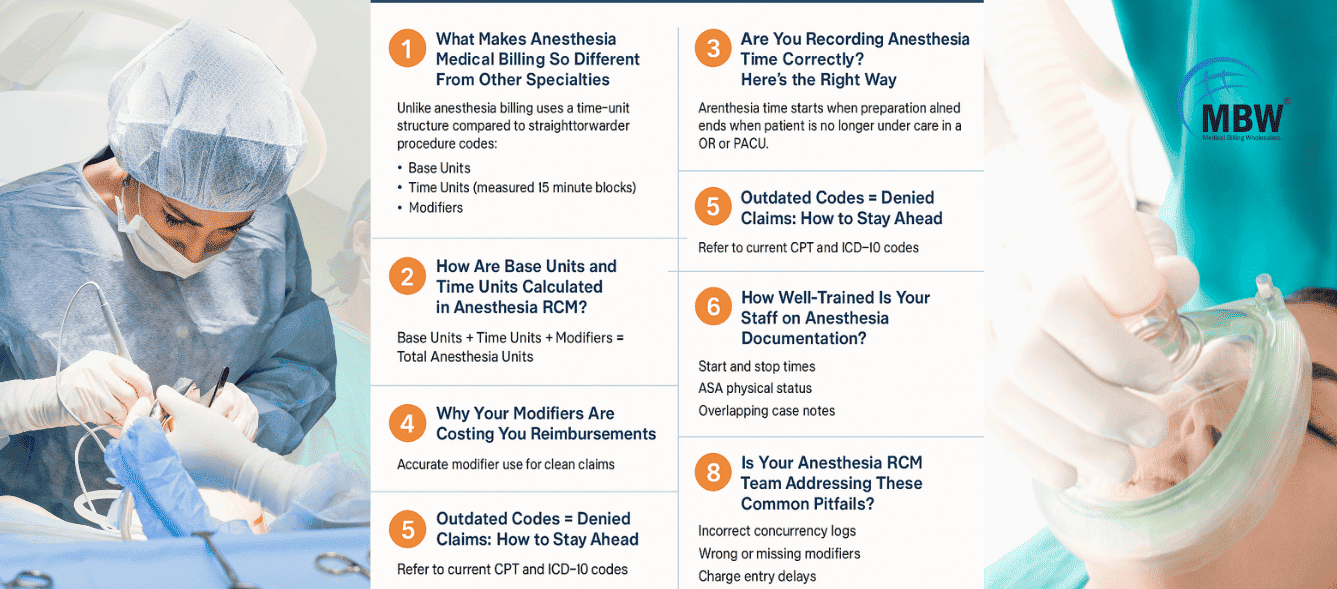
Anesthesia billing and coding require specialized expertise due to the unique structure of time-based reimbursement, base unit calculations, and supervision modifiers. Anesthesia services may be performed by anesthesiologists, CRNAs, or anesthesiologist assistants — each role affects billing structure, modifier usage, and reimbursement calculations.
Core Components of Anesthesia Billing
Anesthesia billing follows a structured reimbursement methodology based on documented clinical services and time spent administering anesthesia:
- Base Units: Assigned per procedure based on complexity, forming the foundation of anesthesia payment.
- Time Units (15-min increments): Anesthesia time must be documented precisely in 15-minute increments.
- AA Modifier: Anesthesia personally performed by an anesthesiologist.
- QK Modifier: Medical direction of two, three, or four concurrent procedures.
- QY Modifier: Medical direction of one CRNA by an anesthesiologist.
- QZ Modifier: CRNA service without medical direction by a physician.
- QX Modifier: CRNA service with medical direction by a physician.
- Bundled Service Awareness: Certain services are bundled into the anesthesia payment and cannot be billed separately.
Anesthesia Modifiers Explained
✓
AA — Anesthesia services personally performed by an anesthesiologist.
✓
QK — Medical direction of two to four concurrent anesthesia procedures.
✓
QY — Medical direction of one CRNA by an anesthesiologist.
✓
QZ — CRNA service without medical direction.
✓
QX — CRNA service with medical direction.
Anesthesia Reimbursement Formula
Anesthesia reimbursement follows a standardized formula:(Base Units + Time Units + Modifying Units) × Conversion Factor = ReimbursementUnderstanding and correctly applying each component is essential for accurate billing. Certain procedures are bundled with anesthesia services and typically should not be billed separately, including diagnostic or therapeutic injections (62320–62321, 62324–62325), nerve blocks (64400–64530), transesophageal echocardiography (93312–93318), laryngoscopy (31505, 31515, 31527), and bronchoscopy (31622, 31645, 31646). Awareness of these bundling rules helps prevent claim denials and compliance issues.
✓
Base and time unit accuracy: Correct calculation of base units and 15-minute time increments for each case.
✓
Modifier application: Correct use of AA, QK, QY, QZ, and QX modifiers to reflect provider role.
✓
Bundled service awareness: Identifying services bundled with anesthesia that should not be billed separately.
✓
Pre- and post-operative documentation: Clinical documentation supporting risk assessment and safe recovery.
✓
Denial analysis and prevention: Root cause identification and preventive measures to reduce future denials.
MBW RCM supports anesthesia billing across the full range of anesthesia care models — topical infiltration, local anesthesia, digital, metacarpal, and metatarsal nerve blocks, regional and peripheral nerve blocks, epidural and spinal anesthesia, and monitored anesthesia care (MAC). Our team applies precise base and time unit coding, correct modifier application, and bundling awareness across every provider type and care setting, backed by consistent A/R follow-up, prior authorization monitoring, and credentialing verification.
CODING REFERENCE
Common CPT Codes Used in Anesthesia Billing
00100–01999
Anesthesia procedure code range, by anatomical site
01967
Anesthesia for labor epidural
99100
Qualifying circumstance, anesthesia for patient of extreme age
99140
Qualifying circumstance, anesthesia complicated by emergency conditions
Modifier AA
Anesthesia services performed personally by anesthesiologist
Modifier QK/QX/QY
Medical direction and CRNA supervision modifiers
Benefits of Our Anesthesia Billing & Coding Services
Enhanced Billing Accuracy: Precise base unit, time unit, and modifier coding reduces errors and denials on every case.
AAPC-Certified Coding Expertise: Certified specialists with deep knowledge of time-based reimbursement, provider role modifiers, and anesthesia coding standards.
Streamlined Perioperative Revenue Cycle: Structured workflows from pre-operative evaluation through post-operative documentation and A/R follow-up.
More Time for Patient Care: Outsourced billing management frees your clinical staff to focus on patients, not paperwork.
Cost-Effective Delivery: Our offshore team lowers administrative overhead and reduces re-work while maintaining high-quality, compliant service.
Advanced Reporting & Compliance: Dashboards tracking claims, denials, and revenue performance, backed by strict CMS-compliant bundling accuracy.
PROVEN SCHEDULING OUTCOMES
Real Results for Anesthesia Billing & Coding Services

Latest Anesthesia Billing & Coding Services Insights




Frequently Asked Questions
GET STARTED
Elevate Your Anesthesia Practice's Financial Performance
Connect with our expert billing team now and experience the difference in accuracy, efficiency, and revenue.
Talk to an Advisor
Please note, if you are interested in careers, click here to visit our career page.
To learn more, visit our Privacy Policy.